

Some of the links in this article are affiliate links, which means we may earn a commission if you click and make a purchase or submit your information. This comes at no additional cost to you and helps support our work. Learn more.
President Donald Trump is once again sounding the alarm on shifting global alliances, warning that both India and Russia appear to be sliding deeper into Beijing’s orbit.
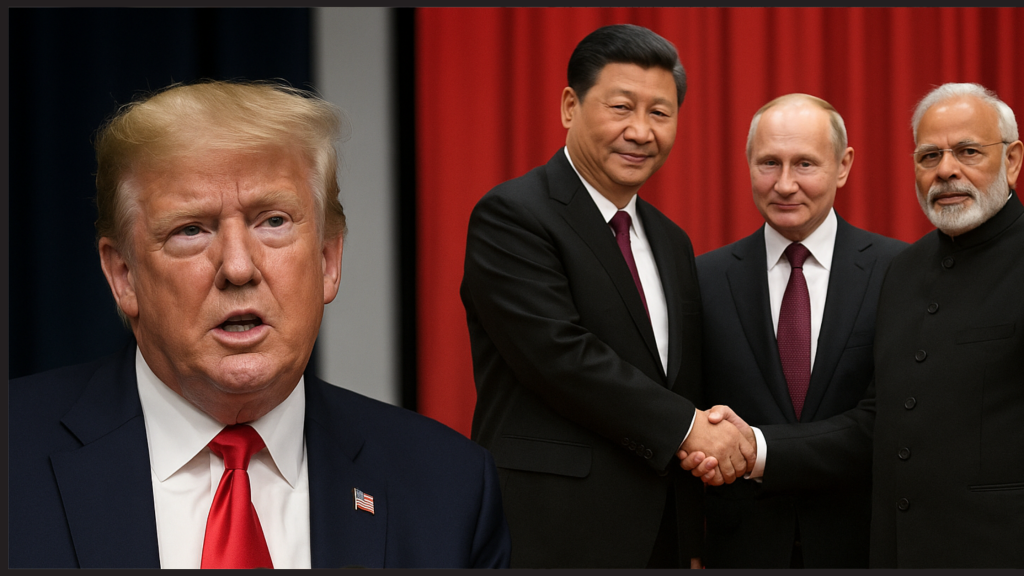
His comments come after Chinese President Xi Jinping hosted Russian President Vladimir Putin and Indian Prime Minister Narendra Modi at the Shanghai Cooperation Organization (SCO) summit in Tianjin, followed by a lavish military parade in Beijing.
“Looks like we’ve lost India and Russia to deepest, darkest, China. May they have a long and prosperous future together!” Trump wrote on Truth Social Friday, posting an image of the three leaders together.

Protect Your Retirement Savings
Free Guide Reveals How to Buy Silver & Gold with Your 401(k) or IRA
Beijing’s New Axis of Power
The SCO, originally created as a security bloc to blunt American influence in Central Asia, has evolved into a key forum for nations challenging Washington. At this year’s summit, Xi, Putin, and Modi openly celebrated closer ties — a move Trump blasted as evidence of a new anti-U.S. bloc emerging on the world stage.
The gathering was joined by North Korean dictator Kim Jong Un, further underscoring the deepening coordination among regimes hostile to America’s interests.
During the parade, Modi was even spotted clasping hands with Putin — a symbolic gesture Trump derided as part of Beijing’s stage-managed display.
“I thought it was very, very impressive, but I understood the reason they were doing it. And they were hoping I was watching — and I was watching,” Trump said of China’s military show.
Tariffs, Trade, and Tensions
The Trump administration has already moved aggressively against New Delhi, hitting India with steep tariffs — including a 50% levy on Indian goods — in response to what it sees as opportunistic oil purchases from Russia and unfair trade barriers against U.S. firms.
Moscow, meanwhile, continues to tighten its energy partnership with both China and India, helping fuel their economies while shrugging off Western sanctions.
Earlier this week, Trump accused Beijing, Moscow, and Pyongyang of “conspiring against the United States” during their public show of unity. While Russia and China downplayed the suggestion, Washington’s concerns about the alignment of these regimes are growing.
A Warning for Washington
For Trump, the spectacle was more than just optics. It was a reminder that the world is rapidly reorganizing in ways that challenge American strength.
By his account, weak leadership under Democrats in recent years left room for China to expand its influence — drawing in India and Russia and building alliances that could reshape the balance of power in the 21st century.
“May President Xi and the wonderful people of China have a great and lasting day of celebration. Please give my warmest regards to Vladimir Putin, and Kim Jong Un, as you conspire against The United States of America,” Trump quipped in a separate post, mixing irony with sharp criticism.
Related: How to Buy Silver and Gold with Your Retirement Savings
Whether intentional or not, India and Russia’s embrace of Beijing marks a troubling shift for Washington. With China pushing to cement its role at the center of a new world order, Trump’s warning may prove to be more than just political theater — it could be a preview of America’s next great geopolitical challenge.
Financial Fallout: What This Means for Markets
For American consumers and investors, the stakes go beyond geopolitics. A tighter Beijing–Moscow–New Delhi axis could rewire global trade, weaken the U.S. dollar’s standing, and drive more countries to settle transactions outside of America’s financial system.
That shift would put pressure on U.S. markets, potentially fueling inflation and raising costs for imports.
Related: Gold Hits New All-Time High as Americans Seek Safe-Haven
Energy and commodities markets are especially vulnerable. Russia’s partnership with India and China provides a lifeline for its oil exports, undermining Western sanctions and keeping energy prices higher worldwide. Meanwhile, China’s dominance in critical minerals and manufacturing further tilts the balance against Washington.
In times of global realignment, safe-haven assets like gold and silver historically surge as retirement savers and global investors look for stability outside of fiat currencies.
With Trump warning of America “losing” two major powers to Beijing’s orbit, markets may see fresh waves of volatility — and precious metals could once again become the hedge of choice for those bracing for uncertainty.
Protect Your Retirement Savings
Free Guide Reveals How to Buy Silver & Gold with Your 401(k) or IRA
