


Some of the links in this article are affiliate links, which means we may earn a commission if you click and make a purchase or submit your information. This comes at no additional cost to you and helps support our work. Learn more.
On April 23, 2026, American Hartford Gold hosted a webinar focused on gold, silver, and the economic pressures facing American retirement savers.
The discussion was led by Machi Block, Senior Director at American Hartford Gold, who walked viewers through concerns surrounding the U.S. dollar, government debt, inflation, interest rates, stock market valuations, and growing global demand for precious metals.
For those who want to watch the full presentation, the complete webinar can be viewed here or on YouTube:
Protect Your Retirement Savings
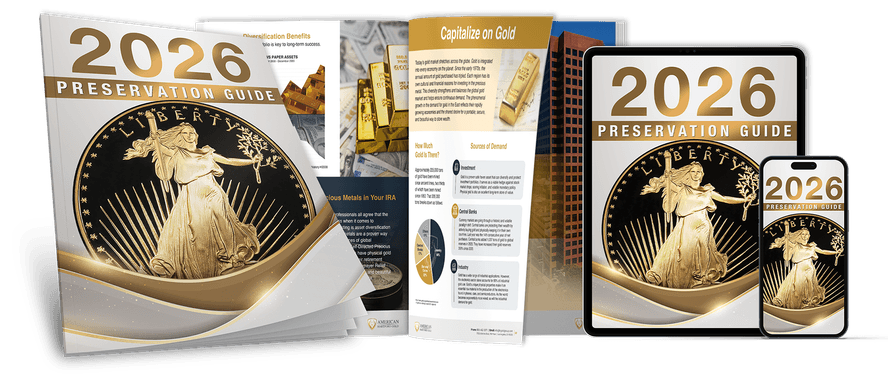
Free Guide Reveals How to Preserve Wealth with Gold & Silver
For readers who prefer to skim, here are the key takeaways from the webinar.
Why More Americans Are Looking at Gold and Silver
The central message of the webinar was simple: many Americans are worried that traditional paper assets may be more vulnerable than they appear.
Block argued that retirement savers are facing a rare combination of risks, including elevated government debt, persistent inflation pressure, geopolitical uncertainty, a volatile stock market, and weakening confidence in the U.S. dollar.
In that environment, American Hartford Gold says more savers are looking for assets outside the traditional Wall Street system.
Gold and silver were presented not just as investments, but as tangible assets that may help protect purchasing power when the dollar weakens or markets become unstable.
Concern #1: Government Debt and the Risk of a “Debt Doom Loop”

Machi Block, Senior Director at American Hartford Gold
A major theme of the webinar was the size of the national debt and what happens when the government must continue borrowing at higher interest rates.
Block described a potential “debt doom loop,” where rising debt forces the Treasury to issue more debt, higher rates are needed to attract buyers, and those higher rates make the debt burden even harder to manage. The concern is that this cycle could eventually undermine confidence in U.S. Treasuries and the dollar itself.
For conservative savers, this is one of the biggest long-term concerns. The federal government has shown little appetite for real spending restraint, and both parties have contributed to rising debt over time. When Washington keeps borrowing, printing, and spending, ordinary Americans are often left dealing with the consequences through higher prices and a weaker dollar.
Visit American Hartford Gold to learn more.
Concern #2: The Dollar’s Declining Purchasing Power
The webinar also focused heavily on the declining value of the U.S. dollar.
Block argued that the issue is not just whether the dollar remains the world’s reserve currency. The more personal question is what the dollar can actually buy over time. Even if inflation cools from crisis levels, the purchasing power of savings can continue to erode year after year.
That point matters for retirees and near-retirees. A retirement account may show a large number on paper, but if the cost of food, energy, insurance, housing, and healthcare keeps rising, the real value of that nest egg may be weaker than it looks.
American Hartford Gold’s argument is that physical gold and silver can serve as a hedge against that erosion because they are not created by government decree and cannot be printed like fiat currency.
Related: Jeremy Herrell's Crest Report Brings Gold & Silver Education to LFA TV
Protect Your Retirement Savings
Free Guide Reveals How to Preserve Wealth with Gold & Silver
Concern #3: De-Dollarization and Central Bank Gold Demand
Another key point from the webinar was the global move away from dependence on the U.S. dollar.
Block discussed foreign governments, central banks, and large institutions buying gold as part of a broader reserve diversification strategy.
The webinar framed this as a signal that ordinary Americans should pay attention to what governments and major financial players are doing, not just what they are saying.
The logic is straightforward: if central banks are increasing gold reserves while concerns rise about the dollar, debt, and geopolitical instability, individual savers may want to consider whether their own portfolios are too heavily exposed to dollar-based assets.
Concern #4: Stock Market Valuations and Portfolio Risk
The webinar also warned that the stock market may be carrying more risk than many retirement savers realize.
Block argued that stocks are historically expensive by several valuation measures and that investors should think carefully about how much of their retirement savings are exposed to equities, bonds, and other dollar-based assets.
The concern is not that stocks cannot continue rising. The concern is that when valuations are stretched, any recession, earnings slowdown, oil shock, interest-rate surprise, or geopolitical event can trigger a sharp decline.
For Americans who are close to retirement, that matters. A younger worker may have decades to recover from a market crash. Someone in or near retirement may not have that luxury.
Request more information from American Hartford Gold's website.
Gold as a Hedge, Not Just a Speculation
One of the stronger points in the webinar was the distinction between gold as a short-term trade and gold as a long-term hedge.
Gold does not pay dividends, and it should not be viewed the same way as a stock in a growing company. Its appeal is different. Gold is often used as a store of value, a hedge against currency weakness, and a form of financial insurance.
That does not mean gold and silver are risk-free. Prices can rise and fall. But American Hartford Gold’s position is that precious metals can help diversify a portfolio that is otherwise heavily tied to paper assets, the dollar, and the financial system.
Gold vs. Silver: Preservation vs. Growth Potential
Block also discussed the difference between gold and silver.
In the webinar, gold was framed more as a preservation asset, while silver was described as having more growth potential. That is a common way precious metals dealers explain the two metals.
Gold is typically viewed as the more established safe-haven asset, while silver can be more volatile but may offer stronger upside during certain precious metals cycles.
For retirement savers, the right mix depends on goals, risk tolerance, time horizon, and whether the metals are being purchased for preservation, growth, or a combination of both.
Protect Your Retirement Savings
Free Guide Reveals How to Preserve Wealth with Gold & Silver
Two Paths to Buying Precious Metals
The webinar outlined two main ways to buy precious metals through American Hartford Gold.
The first is a cash purchase. This involves using money from a bank account, CD, savings account, or other non-retirement source to buy physical gold and silver. According to the webinar, customers can choose to have metals shipped to their home or stored in a private depository.
The second option is a precious metals IRA. For those with eligible retirement accounts, American Hartford Gold says it can help open a self-directed IRA that allows physical gold and silver to be held inside a retirement account. In that case, the metals must be stored at an approved depository to maintain the IRA structure.
The webinar also noted that American Hartford Gold has minimums for purchases and IRA rollovers, and that customers should speak with an account executive for details.
Related: Gold IRA Tax Rules - The IRS and Your Precious Metals
Why This Message Resonates With Conservative Retirement Savers
The webinar’s message is likely to resonate with conservative investors because it taps into several concerns that have been building for years: Washington’s debt addiction, inflation, the Fed’s money-printing role, the weakening dollar, and the risk of relying too heavily on Wall Street.
For many Americans, the issue is not just whether gold goes up this month or next quarter. The bigger question is whether their savings are protected if the financial system becomes more unstable.
That is where gold and silver continue to attract attention. They are tangible, globally recognized, and historically viewed as stores of value during periods of uncertainty.
It's About Diversification
American Hartford Gold’s recent webinar made the case that precious metals deserve a closer look in today’s economy.
The company pointed to debt, inflation, dollar weakness, central bank demand, stock market risk, and geopolitical uncertainty as reasons retirement savers may want to consider adding physical gold or silver to their broader financial strategy.
Of course, precious metals are not suitable for everyone, and they should not be treated as a guaranteed path to profits. Prices can fluctuate, and retirement decisions should be made carefully.
But for Americans who are concerned about the direction of the dollar, the size of the national debt, and the volatility of traditional markets, the webinar offered a timely reminder: diversification is not just about owning different paper assets. Sometimes, it means owning something real.
Claim your free guide from American Hartford Gold's website.
Protect Your Retirement Savings
Free Guide Reveals How to Preserve Wealth with Gold & Silver
