

Some of the links in this article are affiliate links, which means we may earn a commission if you click and make a purchase or submit your information. This comes at no additional cost to you and helps support our work. Learn more.
For decades, the basic American retirement formula was relatively straightforward: work, save, pay into Social Security, perhaps earn a pension, and eventually enjoy a reasonably secure retirement.
That formula is becoming harder to sustain.
Social Security is approaching a major funding shortfall. Medicare faces its own financial pressures. Millions of Americans believe they are behind on retirement savings.
Healthcare remains expensive, people are spending more years in retirement, and the federal government is already running enormous deficits.
Individually, each of these problems is manageable.
Together, they point toward something much larger: a potential retirement crisis that Washington will eventually have to confront.
The uncomfortable question is not simply whether Social Security or Medicare will survive. Both programs almost certainly will.
The real question is who ultimately pays to keep America's retirement system functioning?
Current retirees? Future retirees? Workers? Taxpayers? Higher earners? Or everyone indirectly through higher taxes, additional government borrowing and potentially more inflation?
There are no painless answers.

Gold IRA Company Checklist 
5 Essential Questions to Ask
Before Choosing a Gold IRA Company.
Use This Free Guide to
Compare Gold Dealers Today.
Social Security's Clock Is Ticking
Social Security is not disappearing. But the program's finances are deteriorating rapidly enough that retirement savers should understand what is coming.
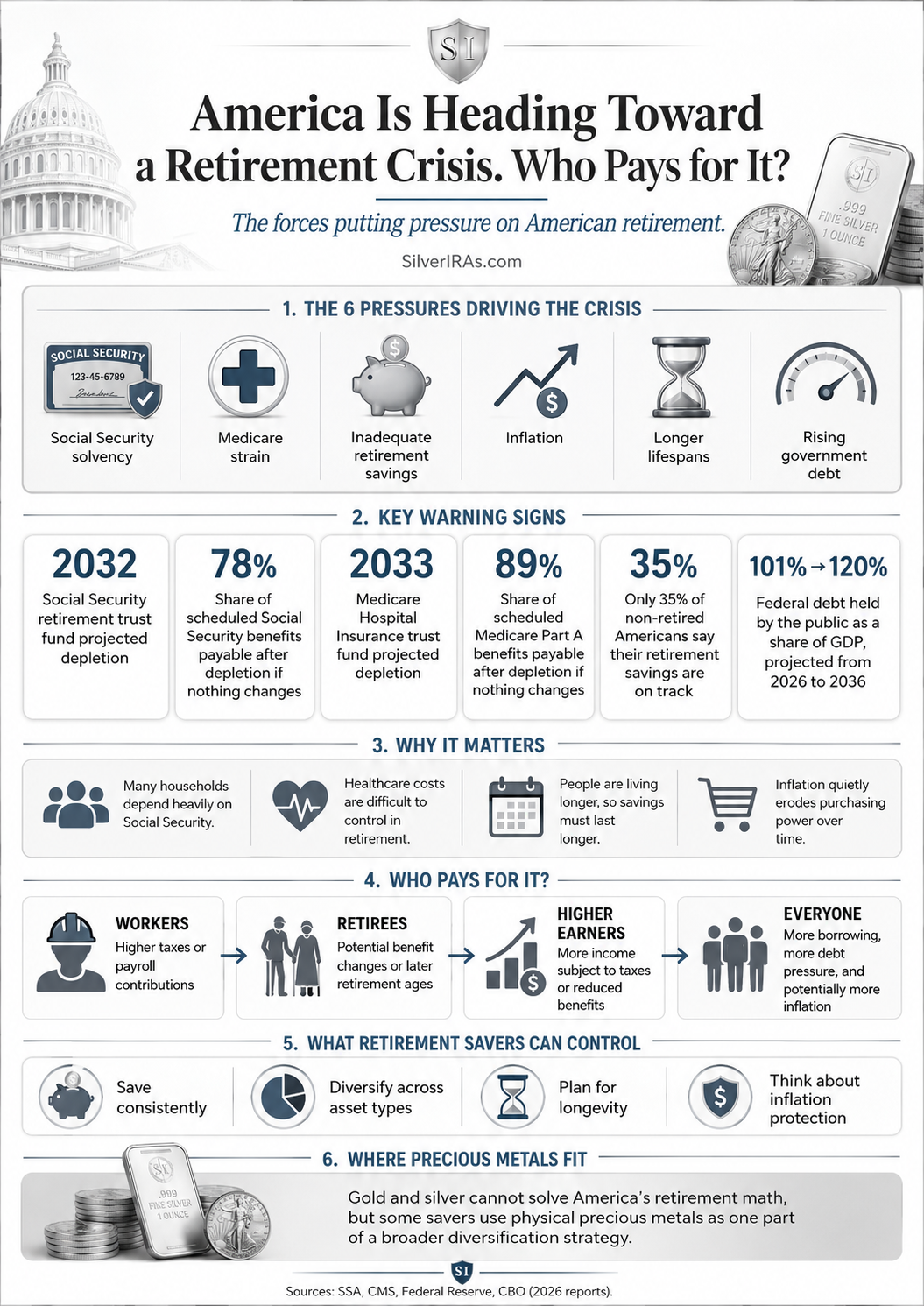
According to the 2026 Social Security Trustees Report, the Old-Age and Survivors Insurance Trust Fund, which pays retirement and survivor benefits, is projected to exhaust its reserves in the fourth quarter of 2032.
If Congress makes no changes, incoming revenues would be sufficient to cover approximately 78% of scheduled benefits at that point.
That translates to a potential funding gap of roughly 22%.
This does not mean Social Security checks suddenly go to zero. Payroll taxes would continue flowing into the system.
But it does mean that the government has promised more in future benefits than the program is currently structured to finance.
And 2032 is no longer some distant problem for future generations.
Someone who is 60 today could encounter Social Security's funding crisis during the first few years of retirement.
Congress therefore faces some combination of politically difficult choices.
Benefits could be reduced. Payroll taxes could rise. The taxable wage ceiling could be increased. Retirement ages could change. General federal revenues could be used to support the program. Or lawmakers could adopt some combination of these approaches.
Almost every solution creates winners and losers.
Medicare Has a Funding Problem Too
Social Security receives more attention, but healthcare may ultimately pose an even greater challenge for retirees and the federal budget.
The 2026 Medicare Trustees Report projects that Medicare's Hospital Insurance Trust Fund, which primarily finances Medicare Part A, will exhaust its reserves during the second quarter of 2033.
At that point, continuing revenue would cover approximately 89% of scheduled Part A benefits.
Again, Medicare would not simply disappear.
But the funding gap would have to be addressed somehow.
The Medicare trustees also emphasize the underlying demographic problem: the large baby-boom generation continues moving through retirement while healthcare utilization generally increases as people age. Medicare covered approximately 69.3 million people during 2025, including more than 62 million Americans age 65 or older.
Unlike many household expenses, healthcare costs can also be difficult for retirees to control.
You can postpone a vacation or buy a less expensive car. You cannot necessarily postpone cancer treatment, heart surgery or prescription medication.
That makes Medicare's financial condition particularly important to America's retirement outlook.
Related: Robert Kiyosaki Warns - The Dollar is Dying (and What to Do About It)
Americans Are Not Saving Enough to Fill the Gap
If Social Security and Medicare were facing financial pressure while Americans were accumulating enormous private retirement balances, the problem might be less concerning.
That is not what the data show.
The Federal Reserve's latest Report on the Economic Well-Being of U.S. Households found that only 35% of non-retired Americans believed their retirement savings were on track in 2025.
In other words, nearly two-thirds did not say they were on track.
That matters because responsibility for retirement has increasingly shifted toward individuals.
Traditional defined-benefit pensions guaranteed workers an income stream based on salary and years of service. Many private-sector workers today instead rely primarily on 401(k)s, IRAs and personal savings.
That creates far more individual control, but also far more individual responsibility.
Workers must decide how much to save, where to put the money, how aggressively to allocate it, when to retire and how quickly to spend it.
A household that reaches retirement with insufficient savings becomes more dependent on Social Security at precisely the moment Social Security itself is approaching a financing crunch.
That is where these separate problems begin reinforcing one another.
Related: Diversify Your Retirement with Gold and Silver
Retirement Is Lasting Longer
There is another factor that rarely receives enough attention: retirees need their money to last a long time.
Social Security actuarial tables indicate that someone reaching age 65 today can reasonably expect another two decades of life on average, with women generally living longer than men.
Of course, averages can be misleading for retirement planning.
The financial danger is not dying at the average life expectancy.
It is living well beyond it.
Someone retiring at 65 may need to finance 25 or 30 years of housing, food, utilities, taxes, insurance, healthcare and everyday living expenses.
A married couple also has to consider the possibility that one spouse could live significantly longer than the other.
Longevity is a wonderful development from a human perspective.
Financially, however, it creates what retirement planners call longevity risk: the possibility of outliving your money.

Protect Your Retirement Savings
Free Guide Reveals How to Buy Silver & Gold with Your 401(k) or IRA
Inflation Quietly Makes Every Retirement Problem Worse
Then there is inflation.
Inflation does not have to reach crisis levels to damage retirement plans.
Even moderate price increases compound dramatically over a long retirement.
A retiree who plans around today's grocery bills, insurance premiums, property taxes, utilities and healthcare expenses may discover that those same necessities cost substantially more 10 or 20 years later.
The Federal Reserve's 2025 household survey found that price increases remained the most widespread financial concern among Americans, with more than nine in ten adults describing them as at least a minor concern.
Social Security does include annual cost-of-living adjustments, which provides retirees with important inflation protection.
But Social Security is only one component of retirement income.
Cash savings can lose purchasing power. Fixed pension payments may not fully adjust for inflation. Healthcare expenses can increase rapidly. Housing and insurance costs can rise.
And retirees have fewer opportunities than younger workers to compensate by increasing their income.
Someone who is 35 can seek a higher-paying job.
Someone who is 85 generally cannot.
Related: Phillip Patrick Discusses Debt, the Dying Dollar, and Gold
Washington Is Entering This Crisis With Enormous Debt
This is where America's retirement problem collides with America's fiscal problem.
The federal government already spends more than it collects.
According to the Congressional Budget Office's February 2026 Budget and Economic Outlook, the federal budget deficit is projected at approximately $1.9 trillion in 2026. CBO projects federal debt held by the public will rise from roughly 101% of GDP in 2026 to 120% by 2036.
That would surpass the previous record relative to the size of the economy following World War II.
Interest costs are an increasingly important part of the equation as well. CBO expects rising net interest expenses to contribute significantly to growing federal deficits over the coming decade.
That leaves Washington with less room to maneuver.
It is one thing to rescue an underfunded retirement program when the federal balance sheet is strong.
It is another to do so while borrowing trillions of dollars annually and simultaneously financing defense, healthcare, interest on the debt and every other function of government.
This does not mean the United States is about to default on its obligations.
It does mean future lawmakers will face increasingly difficult tradeoffs.
So Who Pays for the Retirement Crisis?
Ultimately, there are only a handful of ways governments can close large financial gaps.
Workers can pay more.
Payroll taxes or other taxes could increase to provide additional revenue for Social Security and Medicare.
Retirees can receive less.
Benefits could be adjusted, eligibility rules changed or retirement ages increased.
Higher earners could pay more.
Congress could subject additional income to Social Security taxes, increase Medicare-related taxes or reduce benefits for wealthier households.
The government can borrow more.
Washington could supplement retirement programs with general revenues financed partly through additional federal debt.
Or policymakers can use some combination of all of the above.
That final outcome may be the most politically realistic.
The problem is that borrowing does not eliminate costs. It postpones them.
Future taxpayers still have to service the debt.
And if persistent deficits ultimately contribute to inflationary pressure or declining confidence in government finances, households may experience the cost indirectly through diminished purchasing power.
There is no magical sixth option.
Someone eventually pays.
Related: Diversify Your Retirement with Gold and Silver
Why Washington Keeps Delaying the Problem
None of these challenges appeared overnight.
Social Security's demographic problems have been projected for decades.
Medicare's rising costs are equally well documented.
Federal debt has been climbing under Republican and Democratic administrations alike.
Yet comprehensive reform remains extraordinarily difficult because almost every serious solution creates immediate political pain in exchange for long-term fiscal improvement.
Voters dislike tax increases.
Retirees dislike benefit reductions.
Workers dislike higher retirement ages.
Politicians dislike telling any of those groups that the existing promises cannot continue indefinitely without changes.
The easiest option is therefore also the most dangerous: wait.
Each year of delay reduces the number of gradual reforms available and increases the likelihood that eventual changes will need to be larger.
That is not a partisan argument.
It is arithmetic.
Protect Your Retirement Savings
Free Guide Reveals How to Buy Silver & Gold with Your 401(k) or IRA
What Retirement Savers Can Actually Control
Individual Americans cannot repair the Social Security Trust Fund or balance the federal budget.
They can reduce how dependent their own retirement is on Washington getting everything right.
That starts with recognizing that Social Security should generally be viewed as one component of retirement income rather than the entire plan.
Workers can also build multiple sources of retirement assets rather than relying heavily on one pension, one government program or one asset class.
That could include workplace retirement accounts, IRAs, personal savings, stocks, bonds, real estate, cash and other assets appropriate to an individual's financial circumstances.
It also means planning for longer retirements rather than assuming that retirement lasts only 10 or 15 years.
And perhaps most importantly, retirement plans should account for risks that are difficult to predict: inflation, market downturns, rising healthcare expenses, tax changes and changes to government programs.
America's retirement crisis
Where Gold and Precious Metals Fit Into the Conversation
This broader retirement problem also helps explain why some Americans choose to hold physical gold and other precious metals.
Gold does not solve Social Security insolvency.
It does not pay medical bills automatically, produce dividends or guarantee protection from market losses.
And precious metals can fluctuate substantially in price.
Their appeal is different.
Gold exists outside the promises of governments, corporations and financial institutions. It cannot be created through government spending legislation, and its supply cannot be expanded by a central bank with a policy decision.
For that reason, gold has historically been viewed by some savers as a hedge against currency risk, inflation, financial instability and excessive government debt.
The important word is diversification.
A retirement saver does not necessarily have to predict exactly which crisis will occur.
The purpose of diversification is to avoid depending entirely on one outcome.
Someone whose retirement depends almost exclusively on Social Security is making one type of concentrated bet.
Someone holding virtually everything in cash is making another.
Someone whose savings are almost entirely tied to the stock market is making another.
Physical precious metals, including gold and silver, can potentially serve as one additional component alongside more traditional retirement assets.
Certain IRS-approved gold and other precious metals can also be held through a self-directed IRA, commonly referred to as a Gold IRA, although these accounts involve special custodial, storage, eligibility and tax rules.
Related: Augusta Precious Metals Review - Trusted for Physical Gold and Silver?
America's Retirement Reckoning Is Getting Closer
None of this means America's retirement system is about to collapse.
Social Security will continue collecting payroll taxes. Medicare will continue receiving revenue. Congress has numerous ways to modify both programs.
The danger is assuming that because politicians will eventually act, today's promises will necessarily remain unchanged.
The federal government's own projections are warning that major retirement programs face financing shortfalls within roughly the next decade.
At the same time, only about one-third of non-retired Americans believe their retirement savings are on track, while federal debt continues moving toward historically unprecedented levels relative to the economy.
That combination deserves attention.
The coming retirement crisis may ultimately be resolved through higher taxes, benefit reforms, additional borrowing or some combination of the three.
Americans cannot know today exactly which path Washington will choose.
But they can recognize one important lesson now:
The more financially self-reliant a household becomes, the less its retirement depends on politicians finding a painless solution to a problem that has no painless solution.
Gold IRA Company Checklist
5 Essential Questions to Ask
Before Choosing a Gold IRA Company.
Use This Free Guide to
Compare Gold Dealers Today.