

Some of the links in this article are affiliate links, which means we may earn a commission if you click and make a purchase or submit your information. This comes at no additional cost to you and helps support our work.
Not every silver coin or bar can be held inside an individual retirement account.
Silver is normally treated as a collectible under federal tax law. However, Congress created exceptions for certain coins and qualifying bullion held by an eligible IRA trustee or custodian.
That is where the phrase “IRA-approved silver” comes from. It is useful shorthand, but it can also be misleading. The IRS does not maintain a consumer-friendly catalog of approved brands and products. Instead, federal law defines which coins and bullion are excluded from the collectibles rule, and IRA custodians decide which qualifying products they are willing to administer.
This guide explains the silver purity rule, lists common IRA-eligible coins and bars, identifies products that usually do not qualify, and shows how to verify eligibility before retirement funds are used for a purchase.
Table of Contents
- What Does “IRA-Approved Silver” Actually Mean?
- The IRS Rule: Silver Fineness and Qualified Custody
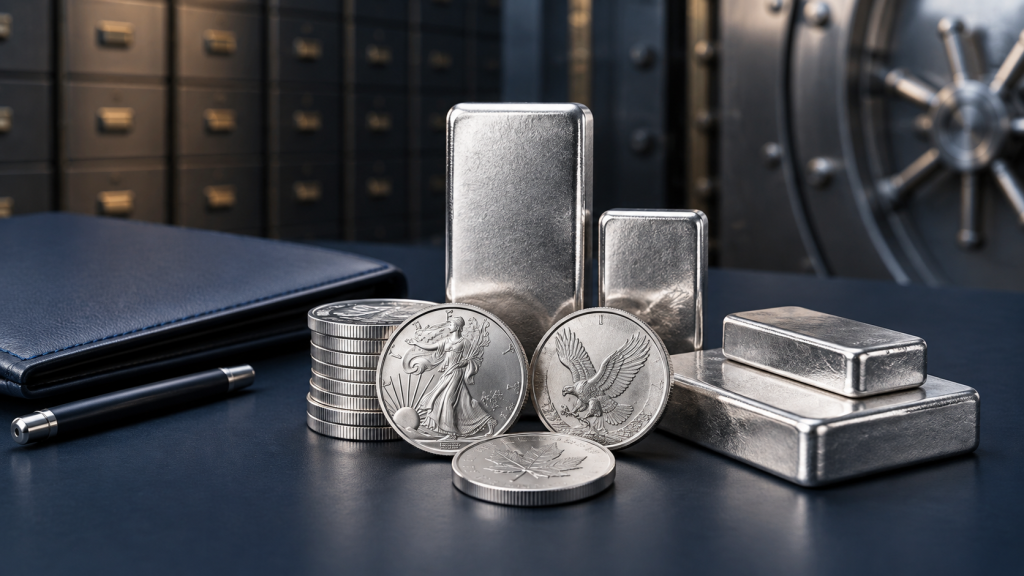
- Common IRA-Eligible Silver Coins
- Which Silver Bars and Rounds Qualify?
- Silver Products That Generally Do Not Qualify
- Can You Put Silver You Already Own Into an IRA?
- Why Home Storage Creates a Tax Problem
- Silver Coins vs. Bars Inside an IRA
- How to Verify Silver Before Your IRA Buys It
- Frequently Asked Questions
- The Bottom Line
What Does “IRA-Approved Silver” Actually Mean?
“IRA-approved” is an industry phrase, not an official certification stamped on a product by the IRS.
Under Section 408(m) of the Internal Revenue Code, metals and coins are generally considered collectibles. If an IRA acquires a collectible, the purchase may be treated as a distribution to the account owner rather than a permitted asset held inside the account.
The law then provides exceptions for specified U.S. coins, coins issued under the laws of a state, and gold, silver, platinum or palladium bullion that meets the applicable fineness standard and remains in the physical possession of a qualified trustee.
In practical terms, a silver product generally needs to clear three hurdles:
- It must fall within a statutory coin exception or meet the required bullion fineness.
- The IRA custodian must approve and administer the exact product.
- The metal must be purchased and held within the IRA structure, not personally purchased and later placed into the account.
This is why a silver round can be .999 fine and still be rejected by a particular custodian. Purity matters, but it is not the only operational requirement.
Related: Silver IRA Guide: How to Buy Silver and Gold With Retirement Savings
The IRS Rule: Silver Fineness and Qualified Custody
The commonly stated purity requirement for silver bullion in an IRA is a minimum fineness of .999, meaning the item contains at least 99.9% pure silver.
The statute itself ties permitted bullion to the minimum fineness accepted for delivery under a regulated futures contract. The IRS explains that qualifying gold, silver, platinum and palladium bullion must meet the applicable fineness standard and be kept in the physical possession of a bank or approved non-bank trustee.
For retirement savers, the practical checklist is simpler:
- Silver bullion: generally .999 fine or better.
- American Silver Eagles: specifically covered by the statutory coin exception and also struck in 99.9% silver.
- Custody: the qualifying metal must be held by the IRA trustee or custodian through the approved storage arrangement.
The storage requirement is just as important as purity. A .999 fine bar kept at home does not automatically become a valid IRA holding simply because its metal content meets the standard.
Common IRA-Eligible Silver Coins
The following bullion coins are commonly accepted by self-directed IRA custodians when the exact issue meets the required specifications:
| Silver coin | Typical purity | Important note |
|---|---|---|
| American Silver Eagle | 99.9% silver | Specifically included under the federal coin exception |
| Canadian Silver Maple Leaf | 99.99% silver | One of the best-known sovereign silver bullion coins |
| Austrian Silver Philharmonic | 99.9% silver | Commonly accepted in precious metals IRAs |
| British Silver Britannia | 99.9% silver for current issues | Confirm the year and specifications with the custodian |
| Australian Silver Kangaroo | 99.99% silver | Produced by The Perth Mint |
| Australian Silver Kookaburra | 99.9% silver or better | Eligibility can depend on the exact issue |
| Australian Silver Koala | 99.9% silver or better | Confirm the product and year before purchase |
| South African Silver Krugerrand | 99.9% silver | The silver version differs from the historic gold coin |
| Mexican Silver Libertad | 99.9% silver | Availability and custodian acceptance may vary |
| Chinese Silver Panda | 99.9% silver | Confirm weight format and current custodian policy |
Two products illustrate how the purity test works. The U.S. Mint lists the one-ounce Silver Eagle proof coin as 99.9% silver, while the Royal Canadian Mint describes the Silver Maple Leaf as one troy ounce of 99.99% pure silver.
Being government-issued does not make every silver coin IRA-eligible. The coin must satisfy the applicable statutory exception or bullion requirements, and the custodian must accept it.
Which Silver Bars and Rounds Qualify?
Qualifying silver bars and rounds generally must be at least .999 fine and produced by a refiner or mint accepted by the IRA custodian and precious metals dealer.
Common IRA-eligible formats include:
- 1-ounce silver bars and rounds
- 10-ounce silver bars
- Kilogram silver bars
- 100-ounce silver bars
- Other .999 or .9999 fine products from recognized refiners
Bars often carry lower premiums per ounce than widely recognized sovereign coins, especially in larger sizes. That can allow more of the IRA purchase price to go toward silver content.
However, larger bars can be less flexible when the account owner eventually wants to sell only a portion of the holdings or take an in-kind distribution. Selling one 100-ounce bar is an all-or-nothing transaction, while one-ounce coins and smaller bars allow more control over the amount sold or distributed.
Custodians and dealers may maintain their own accepted-product lists. Before approving a trade, ask for the exact mint or refiner, weight, fineness and product name in writing.
Silver Products That Generally Do Not Qualify
Many popular silver items do not meet IRA rules. Common examples include:
- Pre-1965 U.S. “junk silver” coins: Dimes, quarters and half dollars containing 90% silver fall below the .999 bullion threshold and are not the Silver Eagle named in the statutory exception.
- Morgan and Peace silver dollars: Most are 90% silver and are commonly purchased as collectible or numismatic coins.
- Silver jewelry and flatware: These are personal or collectible items, not qualifying IRA bullion.
- Rare or graded collectible coins: A high grade, limited population or numismatic premium does not by itself create IRA eligibility.
- Silver-plated products: Plating does not satisfy the bullion purity requirement.
- Coins or rounds with inadequate purity: Products below .999 fine generally fail the silver bullion test unless a specific statutory coin exception applies.
- Personally held silver: Even an otherwise qualifying coin or bar is not automatically eligible to be contributed from your home collection into an IRA.
The last point prevents a common misunderstanding. Product eligibility and transaction eligibility are separate questions. A Silver Eagle may be an eligible product, but that does not mean a personally owned Silver Eagle can simply be deposited into an IRA.
Can You Put Silver You Already Own Into an IRA?
Generally, no. Regular IRA contributions are made in cash, subject to annual contribution limits and other tax rules. Retirement savers normally cannot contribute silver coins or bars they already own as an in-kind annual contribution.
Instead, the usual process is:
- Open a self-directed IRA with a custodian that permits physical precious metals.
- Fund the account with an eligible rollover, transfer or cash contribution.
- Direct the custodian to purchase eligible silver from a precious metals dealer.
- Have the metal shipped to the storage facility used by the IRA arrangement.
For 2026, the general IRA contribution limit is $7,500, or $8,600 for people age 50 or older, according to IRS Publication 590-A. Rollovers and trustee-to-trustee transfers are separate from annual contribution limits when handled correctly.
Related: What Is a Roth Gold IRA?
Why Home Storage Creates a Tax Problem
Section 408(m) requires qualifying bullion to remain in the physical possession of an eligible trustee. The IRS likewise says qualifying bullion must be kept by a bank or approved non-bank trustee.
That rule conflicts with marketing claims that an account owner can freely keep IRA silver in a personal safe while preserving normal IRA tax treatment.
If an IRA owner takes personal possession of the metal outside a permitted distribution, the transaction could be treated as a distribution. That may create taxable income and, depending on the owner’s age and circumstances, an additional early-distribution tax.
This does not mean account owners can never receive their metal. An IRA can make an in-kind distribution, but the distribution must be reported and taxed under the rules that apply to the account.
Silver Coins vs. Bars Inside an IRA
Once eligibility is confirmed, the choice between coins and bars usually comes down to cost, recognition and flexibility.
| Factor | Silver coins | Silver bars |
|---|---|---|
| Premiums | Often higher for sovereign coins | Often lower per ounce, especially in larger sizes |
| Recognition | Widely recognized government-minted products | Depends more heavily on the refiner or mint |
| Partial sales | Easy to sell a smaller number of one-ounce coins | Larger bars offer less flexibility |
| Storage efficiency | Monster boxes can take more space | Bars stack efficiently |
| Counterfeit protection | Sovereign designs and security features may help | Recognized refiners use serial numbers and assay features |
Neither format is automatically better. Customers who prioritize lower costs may favor bars. Those who value divisibility and broad recognition may prefer one-ounce sovereign coins. Many accounts hold a combination.
Ask the dealer for the total spread, not only the advertised price over spot. The cost to buy and the dealer’s current repurchase price provide a clearer picture of the transaction than the retail premium alone.
How to Verify Silver Before Your IRA Buys It
Do not rely only on a product page that uses the words “IRA-approved.” Verify the details before the custodian releases funds.
- Confirm the exact product. Record the mint or refiner, year if applicable, weight and fineness.
- Ask the custodian. Get confirmation that the custodian accepts that exact coin, bar or round.
- Review the invoice. The invoice should clearly identify the product, quantity and price.
- Compare the spread. Ask for both the purchase price and the dealer’s current buyback price for the same product.
- Confirm storage. Know which depository will hold the metal and whether storage is segregated or commingled.
- Keep records. Retain the account documents, trade confirmation, invoice and depository statements.
A reputable dealer should be able to explain why a product qualifies without promising that the IRS has individually endorsed the coin or bar.
Related: Best Silver IRA Companies for 2026
Frequently Asked Questions
What purity does silver need for an IRA?
Silver bullion generally must be at least .999 fine. Certain coins, most notably the American Silver Eagle described in federal law, are covered by a specific statutory exception.
Are American Silver Eagles IRA-eligible?
Yes. American Silver Eagles are specifically covered by the coin exception in Section 408(m) and are struck in 99.9% silver. The custodian must still handle the purchase and custody correctly.
Are proof Silver Eagles allowed in an IRA?
Proof American Silver Eagles are generally accepted because they are Silver Eagles described under the federal coin program. Confirm the exact product and its treatment with the custodian before purchase.
Can an IRA own junk silver?
Pre-1965 U.S. dimes, quarters and half dollars generally contain 90% silver, below the .999 bullion threshold. They are not usually accepted as IRA-eligible silver.
Can I store Silver IRA coins at home?
Federal law requires qualifying bullion to be in the physical possession of an eligible trustee. Personal home storage can create a risk that the metal is treated as distributed from the IRA.
Does the IRS approve individual silver brands?
The IRS explains the categories of coins and bullion that can qualify, but it does not provide a consumer shopping list certifying every brand and product. Custodian acceptance should be confirmed before a purchase.
Can I take physical silver from my IRA when I retire?
An IRA may distribute metal in kind. The fair market value is generally reported as a distribution and taxed according to the type of IRA and the account owner’s circumstances.
The Bottom Line
IRA-approved silver generally means a qualifying coin or bullion product that satisfies federal rules and is accepted by the self-directed IRA custodian.
For most silver bullion, the starting point is .999 fineness. But purity alone is not enough. The purchase must be completed within the IRA, the custodian must accept the exact product, and the metal must remain in the possession of the qualified trustee through the account’s storage arrangement.
American Silver Eagles, Canadian Silver Maple Leafs, Austrian Silver Philharmonics and several other sovereign bullion coins are commonly eligible. Recognized .999 fine bars and rounds may qualify as well. Junk silver, most collectible coins, jewelry and personally held metal generally do not.
Before buying, ask the custodian to confirm the exact coin or bar in writing and compare the dealer’s purchase and buyback prices. That one step can prevent an expensive eligibility mistake.
This article is for informational and educational purposes only and should not be considered financial, investment, tax or legal advice. Consult a qualified tax or financial professional regarding your circumstances.

Gold IRA Company Checklist 
5 Essential Questions to Ask
Before Choosing a Gold IRA Company.
Use This Free Guide to
Compare Gold Dealers Today.
