

Some of the links in this article are affiliate links, which means we may earn a commission if you click and make a purchase or submit your information. This comes at no additional cost to you and helps support our work. Learn more.
Silver is making headlines again, and this time the move is impossible to ignore.
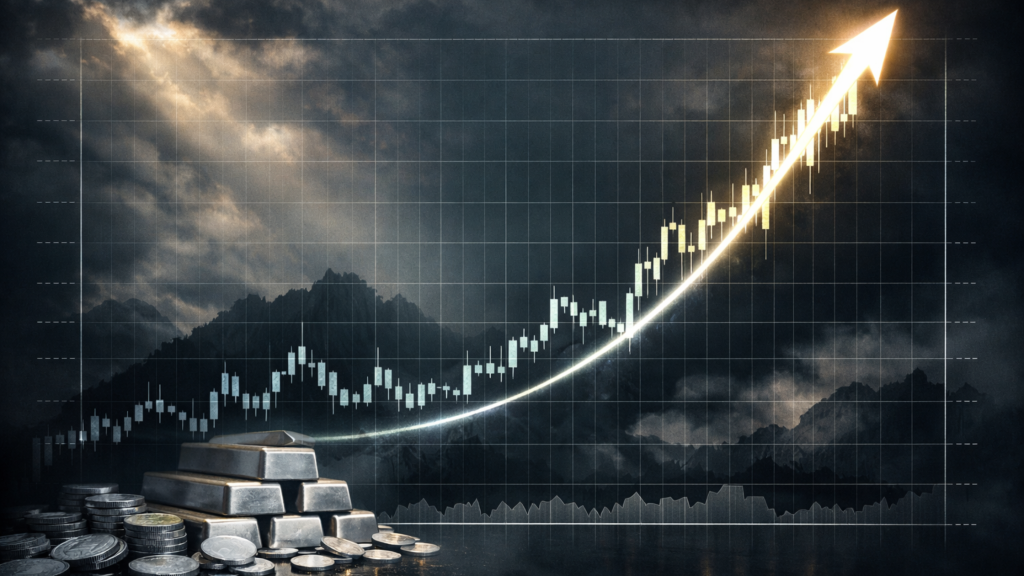
As of today, December 17, 2025, the price of silver has surged to around $65–$66 per ounce, marking a fresh all-time high and capping off one of the strongest years in the metal’s modern history . The rally has been swift, powerful, and most importantly, driven by more than just speculation.
For Americans watching the value of the dollar, inflation, and the long-term stability of the financial system, silver’s rise is sending a clear signal.
This isn’t a meme trade.
This isn’t a short-term panic.
This is a structural move years in the making.

Protect Your Retirement Savings
Free Guide Reveals How to Buy Silver & Gold with Your 401(k) or IRA
Silver at a Glance (December 17, 2025)
- Spot price: ~$65.7–$66.0 per ounce
- Year-to-date performance: Triple-digit percentage gains in 2025
- Momentum: Silver has significantly outperformed gold and most major asset classes this year
Silver’s move has been sharp enough that even mainstream financial media (which often ignores precious metals until it’s too late) is now paying attention.
Why Is Silver Rising So Fast?
The simplest explanation is also the most accurate:
Demand is rising. Supply is not.
And confidence in paper money continues to erode.
According to Reuters, silver’s rally is being driven by a combination of tight physical supply, robust industrial demand, and increasing investor and speculative interest, all amplified by shifting expectations around U.S. interest rates .
Let’s break that down.
1. A Structural Supply Deficit That Won’t Go Away
Silver isn’t rare — but accessible silver is.
The Silver Institute has confirmed that the global silver market is on track for its fifth consecutive annual supply deficit in 2025, with an estimated shortfall of roughly 95 million ounces this year alone .
That matters because silver is consumed.
Unlike gold — which is mostly mined, stored, and reused — silver is heavily used in industrial applications and often not economically recoverable once it’s deployed.
Over the past several years:
- Mine supply has struggled to keep up
- Recycling has failed to close the gap
- Inventories have been steadily drawn down
A market that runs persistent deficits doesn’t stay cheap forever.
Eventually, price becomes the rationing mechanism.
That moment appears to be arriving now.
Related: How to Diversify Your Savings with Silver and Gold
2. Silver Is a Critical Industrial Metal, Not Just a “Safe Haven”
Many Americans still think of silver primarily as “poor man’s gold.”
That view is outdated.
Silver is a strategic industrial metal, essential to:
- Solar panels and renewable energy infrastructure
- Electronics and semiconductors
- Data centers and advanced computing
- Medical and antimicrobial applications
- Electric vehicles and charging systems
Reuters notes that green energy demand has become a major pillar supporting silver prices, alongside traditional investment demand .
Even critics of aggressive climate policy acknowledge reality: the modern economy uses more silver, not less.
And unlike oil or copper, silver has no easy substitute.
When industrial demand rises during a supply deficit, prices don’t drift higher — they jump.
Protect Your Retirement Savings
Free Guide Reveals How to Buy Silver & Gold with Your 401(k) or IRA
3. Cracks in the Dollar and Growing Rate-Cut Expectations
Silver’s rally isn’t happening in a vacuum.
It’s unfolding against the backdrop of:
- Record U.S. national debt
- Persistent inflation pressures
- Growing expectations of Federal Reserve rate cuts
Recent economic data has reinforced the belief that the Fed may be forced to ease monetary policy sooner rather than later. Lower interest rates tend to support precious metals by reducing the opportunity cost of holding hard assets instead of yield-bearing paper .
But for many Americans, the issue isn’t just rates.
It’s trust.
Silver has historically performed well when confidence in fiscal discipline, monetary restraint, and long-term dollar stability weakens.
That backdrop looks increasingly familiar.
Related: Lear Capital Review - Best for Silver Bars and Coins?
4. Momentum and Positioning Are Accelerating the Move
Once silver cleared long-standing resistance levels earlier this year, the rally fed on itself.
Trend-following funds, traders, and institutional players began increasing exposure, adding fuel to a market that was already fundamentally tight. Reuters has pointed specifically to rising speculative interest as a short-term accelerant in silver’s surge .
This helps explain the speed of the move — but not its origin.
Momentum may amplify price action, but it doesn’t create multi-year supply deficits.
Fundamentals do.
What This Means for Physical Silver Buyers
For Americans looking at physical silver — coins and bars — soaring spot prices come with a few important realities:
- Premiums matter more than ever. In fast-moving markets, retail pricing can disconnect from spot.
- Availability can tighten quickly. Dealers don’t control mine supply.
- Timing becomes less about precision and more about discipline.
Silver is volatile by nature. Pullbacks are normal.
But long-term buyers should focus less on day-to-day price swings and more on why silver is repricing in the first place.
That story hasn’t changed — it’s strengthened.
Risks and Counterarguments (Yes, They Exist)
No asset moves in a straight line.
Silver could face pressure if:
- Industrial demand weakens sharply due to a global slowdown
- Interest rates rise unexpectedly
- Speculative froth leads to short-term corrections
Silver has always been more volatile than gold.
That volatility cuts both ways.
Still, none of those risks erase the underlying structural imbalance between supply and demand.
What to Watch Going Forward
If you’re tracking silver in the months ahead, pay close attention to:
- Whether prices hold above the $60–$65 range
- Updates from the Silver Institute on deficits and inventories
- Federal Reserve policy signals
- Industrial demand trends, especially in energy and technology
- Physical availability and retail premiums
These indicators will tell you far more than daily headlines.
Silver's Surge
Silver’s surge in 2025 is not an accident.
It reflects years of policy decisions, supply constraints, and economic realities finally colliding in the price.
For Americans concerned about inflation, debt, and the long-term purchasing power of their savings, silver’s move is less a surprise, and more a confirmation.
Hard assets tend to speak plainly when paper promises begin to strain.
And right now, silver is speaking loudly.
Protect Your Retirement Savings
Free Guide Reveals How to Buy Silver & Gold with Your 401(k) or IRA