

Some of the links in this article are affiliate links, which means we may earn a commission if you click and make a purchase or submit your information. This comes at no additional cost to you and helps support our work. Learn more.
Phillip Patrick of Birch Gold Group recently joined IncomeInsider TV for a thoughtful conversation about gold, inflation, national debt, de-dollarization, and the growing pressure many Americans feel around retirement planning.
Hosted by Sam Laliberte, the interview explored why precious metals continue to come up in conversations about purchasing power, central bank policy, and long-term financial security.
But rather than treating gold as a short-term trade or a simple price chart, Phillip Patrick framed it as part of a bigger question: how can retirement savers protect themselves when confidence in paper money, government debt, and traditional assumptions begins to weaken?
You can watch the full interview below.

Protect Your Retirement Savings
Free Guide Reveals How to Buy Silver & Gold with Your 401(k) or IRA
For readers who prefer to skim the highlights, here are the biggest ideas from the episode.
The Real Question Is Not Gold, It Is Money
At the beginning of the interview, Patrick made an important point: gold is not really the starting point of the conversation. Money is.
When people hear about gold, they often think about whether the price is up or down this week. But Patrick argued that the deeper issue is whether the dollars people save today will hold their value over time.
That matters because most Americans do not experience inflation as an abstract number. They experience it through higher grocery bills, insurance premiums, medical expenses, utility costs, and housing costs. The pressure shows up in the family budget long before it becomes a chart in a financial report.
For retirement savers, that creates a serious question. If someone spends decades building savings, will those savings still buy the lifestyle they expected later on?
Patrick’s point was that gold often becomes relevant when people start asking that question.
Related: Download Birch Gold's Free Precious Metals Kit Today
Purchasing Power Is the Hidden Retirement Risk
A retirement account balance can look strong on paper. But the number itself does not tell the whole story.
The more important question is what those dollars can actually buy.
Patrick explained that the dollar is not a fixed measuring stick. It represents purchasing power, and that purchasing power can rise or fall depending on inflation, monetary policy, debt, and confidence in the broader system.
This is why inflation can be so damaging to retirees. A person may have the same amount of money in the bank, but if food, energy, healthcare, and housing become much more expensive, their real wealth has declined.
That is one of the central reasons gold has historically attracted attention during inflationary periods. It is not because gold solves every financial problem. It is because gold is often viewed as a way to hold value outside a paper currency system that can lose purchasing power over time.
Gold Reflects Confidence in the System
Patrick described gold as a kind of mirror.
When confidence in currency, government debt, or central bank policy weakens, gold often becomes more interesting to savers and institutions. It reflects concerns about the system around it.
That does not mean gold only rises during crisis periods. It also does not mean gold is risk-free. But it does mean that gold plays a different role than many traditional financial assets.
Stocks depend on companies growing earnings. Bonds depend on borrowers repaying debt. Cash depends on the stability of the currency. Gold is different because it is not someone else’s liability. It does not require a government, bank, or corporation to make good on a promise.
For Patrick, that distinction is one of the reasons gold remains relevant in a world of rising debt, inflation concerns, and geopolitical uncertainty.
Cash Provides Safety, But Only Up to a Point
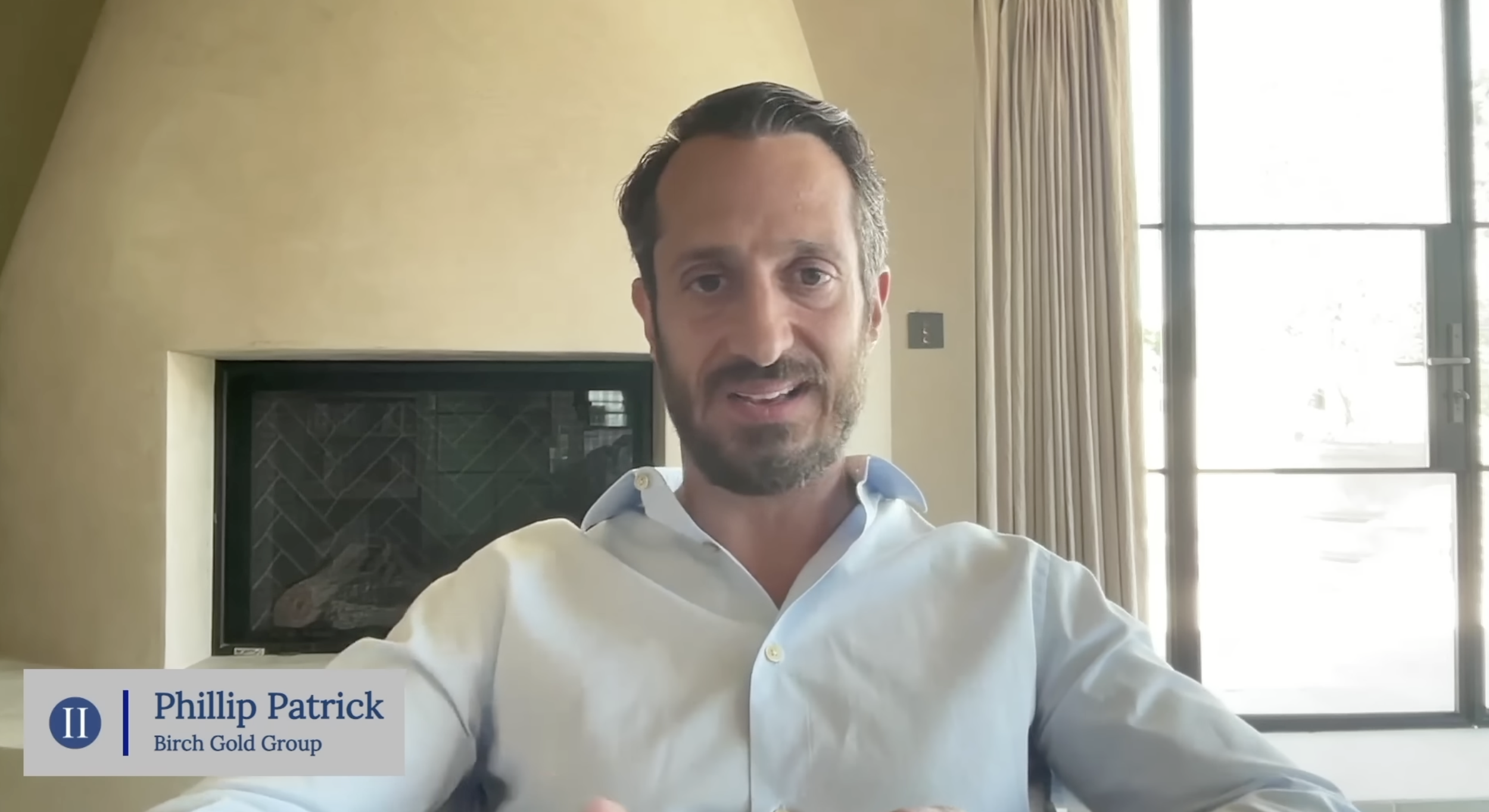
Phillip Patrick of Birch Gold Group
One of the more practical parts of the conversation focused on cash.
Patrick did not dismiss cash. In fact, he said cash absolutely has a role. People need liquidity for emergencies, bills, flexibility, and short-term stability. Retirees especially may need cash to avoid selling investments at the wrong time.
But cash also has a weakness.
It can look safe while quietly losing value.
If someone holds $100,000 in a bank account, the number may still say $100,000 several years later. But if prices have risen sharply during that period, the real buying power of that money has declined.
That is why Patrick separated the role of cash from the role of long-term wealth preservation. Cash may be useful for short-term certainty, but in an inflationary environment, it may not be enough to protect purchasing power over many years.
Visit Phillip Patrick's Website to Learn More.
Debt Is a Retirement Issue, Not Just a Political Issue
The national debt was one of the major themes of the episode.
For many people, the debt feels too large and too abstract to matter in daily life. But Patrick argued that the consequences are already showing up in ways that affect households and retirement savers.
Debt can influence inflation. It can affect interest rates. It can put pressure on the Federal Reserve. It can raise questions about the long-term stability of Treasury markets. It can also influence how foreign governments and investors view the United States as a borrower.
Patrick compared debt to rust. It does not always cause sudden failure. Instead, it slowly weakens the structure over time.
That analogy is useful because it explains why the debt problem can be easy to ignore until the consequences become much harder to manage.
Protect Your Retirement Savings
Free Guide Reveals How to Buy Silver & Gold with Your 401(k) or IRA
America Is Still Strong, But the Numbers Matter
Patrick was not pessimistic about America itself.
He acknowledged that the United States remains one of the most innovative and resilient economies in the world. America has deep capital markets, major companies, natural resources, entrepreneurial energy, and a long history of adapting to major challenges.
But he also argued that even a strong country can create serious problems if debt grows faster than the economy.
In other words, optimism about America does not erase the need to take the math seriously.
If government borrowing continues to expand, if annual deficits remain large, and if debt service costs rise, savers may eventually feel the impact through inflation, taxes, interest rates, market volatility, or reduced confidence in the dollar.
For retirement savers, the lesson is not to bet against America. It is to avoid assuming that America’s strengths automatically eliminate all financial risks.
Related: Best Silver IRA Companies (Ranked and Rated)
De-Dollarization Is a Slow Shift, Not a Light Switch
The episode also covered de-dollarization, one of the most talked-about financial topics in recent years.
Patrick explained that de-dollarization should not be understood as the dollar suddenly disappearing. The U.S. dollar remains deeply embedded in global trade, banking, commodities, and debt markets.
But he also said it would be a mistake to assume nothing is changing.
Some countries are looking for ways to reduce dependence on the dollar. Some are settling more trade in local currencies. Some are exploring alternative payment systems. And many central banks have been adding gold to their reserves.
The key point is that de-dollarization can happen gradually.
It does not need to be dramatic to matter. Even a slow reduction in dollar dependency could have long-term consequences for U.S. borrowing, currency strength, and global financial influence.
Central Bank Gold Buying Deserves Attention
Patrick also discussed why central banks around the world have been buying gold.
His point was simple: central banks are not buying gold because of hype. They are not watching commercials and chasing a trend. They are responsible for managing national reserves, which means they think about safety, liquidity, currency risk, and long-term stability.
Gold has several qualities that make it attractive in that context. It cannot be printed. It is not issued by another country. It does not rely on another government’s promise. It is widely recognized around the world.
For retirement savers, Patrick suggested that this trend is worth noticing. Individuals do not operate like central banks, but they can still ask why large reserve managers are choosing to hold more gold during a period of inflation, debt, geopolitical tension, and currency uncertainty.
Related: How to Diversify Your Savings with Physical Gold and Silver
Gold Should Be Viewed as Diversification, Not a Cure-All
A useful part of Patrick’s message was his emphasis on balance.
He did not argue that savers should move everything into gold. He repeatedly framed precious metals as a diversification tool, not a complete financial plan.
That distinction matters.
Some people dismiss gold entirely. Others become overly convinced that gold is the only asset that matters. Patrick’s position was more measured: gold may have a role because it responds to different forces than stocks, bonds, or cash.
For many retirement savers, most wealth is tied to traditional paper assets. That may include 401(k)s, IRAs, mutual funds, ETFs, stocks, bonds, and cash. Gold can potentially provide exposure to a different type of risk environment, especially one tied to inflation, currency weakness, or declining confidence in government debt.
Precious Metals Require a Long-Term Mindset
Patrick also cautioned against treating physical gold like a short-term trade.
Precious metals can move in price, but they are generally better understood as a long-term asset. People considering gold should think in terms of years, not days or weeks.
This is especially important for retirement savers.
The goal is not to guess tomorrow’s price. The goal is to ask whether gold may help preserve purchasing power and diversify a portfolio over a longer period of time.
Patrick suggested that anyone looking at precious metals should have a reasonable time horizon and should avoid making emotional decisions based on short-term headlines.
Protect Your Retirement Savings
Free Guide Reveals How to Buy Silver & Gold with Your 401(k) or IRA
The Sales Process Matters
One of the most practical warnings from the interview involved high-pressure sales tactics.
Patrick said that if someone feels pressured, rushed, or scared into making a decision, that is a major red flag.
This is important because gold often appeals to people who are already concerned about inflation, markets, debt, or the dollar. That concern can make savers vulnerable to fear-based pitches.
Patrick’s advice was to slow down, get educated, and understand the asset before making a decision. A reputable company should be willing to explain, answer questions, and provide information without pressuring someone to act immediately.
That message fits the broader theme of the interview: preparation is good, panic is dangerous.
Education Comes Before Action
Birch Gold's Phillip Patrick repeatedly encouraged viewers to learn before making any move.
That may sound simple, but it is especially important in a complicated area like precious metals and retirement accounts. Savers should understand the potential benefits, risks, fees, rules, storage requirements, tax considerations, and alternatives before deciding whether gold belongs in their plan.
He also encouraged viewers to use free resources and continue researching on their own.
The more someone understands the issues, the less likely they are to make a rushed decision based on fear or confusion.
Related: What is a Roth Gold IRA?
Waiting for Certainty Can Be a Mistake
Near the end of the interview, Phillip Patrick said one of the biggest mistakes people make is waiting for perfect certainty.
Many savers want a clear signal. They want someone to announce that inflation is permanent, the debt problem has reached a breaking point, or the dollar is officially in trouble.
But markets rarely work that way.
By the time a risk becomes obvious to everyone, the cost of protecting against it may already be higher.
Patrick’s message was not to make reckless moves. It was to be proactive. If a saver is concerned about inflation, debt, or currency risk, the right first step is to learn, ask questions, and think through a plan before panic sets in.
Related: Download Birch Gold's Free Guide Today.
The Big Message: Prepare Calmly
The most important takeaway from the episode may be this: preparation and panic are not the same thing.
Panic leads to rushed decisions. Preparation leads to better questions.
Patrick’s argument was that retirement savers should pay attention to the forces reshaping the financial system. That includes inflation, debt, deficits, central bank behavior, de-dollarization, and the long-term purchasing power of the dollar.
Gold may not be right for everyone. It may not solve every problem. But for savers who are concerned about the paper money system, it may be worth studying as part of a diversified approach.
Related: Why Retirees Are Rethinking their Portfolio in 2026
Understand the Risks
Phillip Patrick’s visit to IncomeInsider TV offered a big-picture look at why gold continues to be part of the retirement conversation.
The episode connected everyday inflation concerns with larger issues like national debt, global trust, de-dollarization, and central bank gold buying. For retirement savers, those topics are not just academic. They can influence the value of savings, the cost of living, and the stability of long-term financial plans.
The key takeaway is not to abandon traditional assets or make fear-based decisions. It is to understand the risks, think carefully about purchasing power, and consider whether physical precious metals deserve a place in a broader retirement strategy.
Watch the full interview above, and visit IncomeInsider.org for additional show notes, resources, and links discussed in the episode.
Protect Your Retirement Savings
Free Guide Reveals How to Buy Silver & Gold with Your 401(k) or IRA

