


Some of the links in this article are affiliate links, which means we may earn a commission if you click and make a purchase or submit your information. This comes at no additional cost to you and helps support our work. Learn more.
Gold has long appealed to retirement savers looking for an asset that behaves differently from stocks, bonds, and cash. But deciding that you want exposure to gold is only the beginning.
The next question is how you want to own it.
Two of the most common choices are a Gold IRA holding physical precious metals and a gold exchange-traded fund, or gold ETF.
Both can give you exposure to changes in the price of gold, but they are very different products. A Gold IRA allows you to own actual gold bars and coins inside a tax-advantaged retirement account. A gold ETF gives you shares of a financial product designed to track the value of gold.
So which is better for your portfolio?
For buyers who primarily want convenience, low costs, and the ability to trade gold quickly, an ETF may be the easier option. For retirement savers who specifically want physical precious metals held outside the traditional brokerage system, a Gold IRA offers something an ETF cannot provide: ownership of actual bullion.
Here is how the two compare.

Protect Your Retirement Savings
Free Guide Reveals How to Buy Silver & Gold with Your 401(k) or IRA
Gold IRA vs Gold ETF at a Glance
Feature | Gold ira | gold etf |
|---|---|---|
What you own | Physical gold bars and coins | Shares of a gold-backed financial product |
Physical gold | Yes | Generally held by the trust, not personally accessible to ordinary shareholders |
Retirement account | Yes | Can be held inside or outside an IRA |
Trading | Dealer transactions | Trades during market hours |
Storage required | Yes | Handled by fund custodian |
Annual costs | Custodian and storage fees | Fund expense ratio |
Typical liquidity | Lower | Very high |
Counterparty / structure exposure | Custodian / depository | Fund sponsor, trustee, custodian and market structure |
Best for | Physical gold ownership within retirement savings | Convenient gold price exposure |
There is an important technical point here: Gold IRAs and gold ETFs are not mutually exclusive account types.
A Gold IRA is generally a self-directed IRA used to hold IRS-permitted physical precious metals. An ETF is an asset. Depending on the brokerage and account, gold ETFs can also be purchased inside traditional or Roth IRAs.
The real comparison, therefore, is usually physical gold held in an IRA versus shares of a gold ETF.
What Is a Gold IRA?
A Gold IRA is a type of self-directed individual retirement account that allows certain physical precious metals to be held as retirement assets.
Federal tax rules generally treat metals and coins as collectibles, which are normally prohibited inside IRAs. However, the Internal Revenue Code provides exceptions for certain qualifying coins and sufficiently pure gold, silver, platinum, and palladium bullion.
Gold commonly purchased for precious metals IRAs includes products such as qualifying American Gold Eagles and certain gold bars meeting applicable purity requirements.
The account must also follow IRA custody rules. The IRS specifically notes that qualifying bullion must be held in the physical possession of a bank or an approved nonbank trustee.
That means buying gold through an IRA is different from buying coins and keeping them in your home safe.
A typical Gold IRA involves three parties:
The custodian administers the IRA.
The precious metals dealer sells the gold.
The depository stores the physical metal on behalf of the retirement account.
The gold belongs to the IRA rather than the custodian, dealer, or depository.
Related: Diversify Your IRA or 401(k) with Physical Gold and Silver (Tax-Free)
What Is a Gold ETF?
A gold ETF or exchange-traded gold product allows you to gain exposure to gold through a brokerage account without personally purchasing individual bars or coins.
One well-known example is SPDR Gold Shares, or GLD. Another is the iShares Gold Trust, or IAU.
GLD holds physical gold and is designed to reflect the performance of gold bullion, less expenses. Its current gross expense ratio is 0.40%.
IAU similarly seeks to reflect the price performance of gold and currently charges a 0.25% sponsor fee.
From the buyer's perspective, purchasing either is similar to buying a stock.
You open your brokerage account, enter the ticker symbol, choose how many shares you want, and place the trade.
There is no precious metals dealer to call, no shipment to arrange, and no separate storage bill.
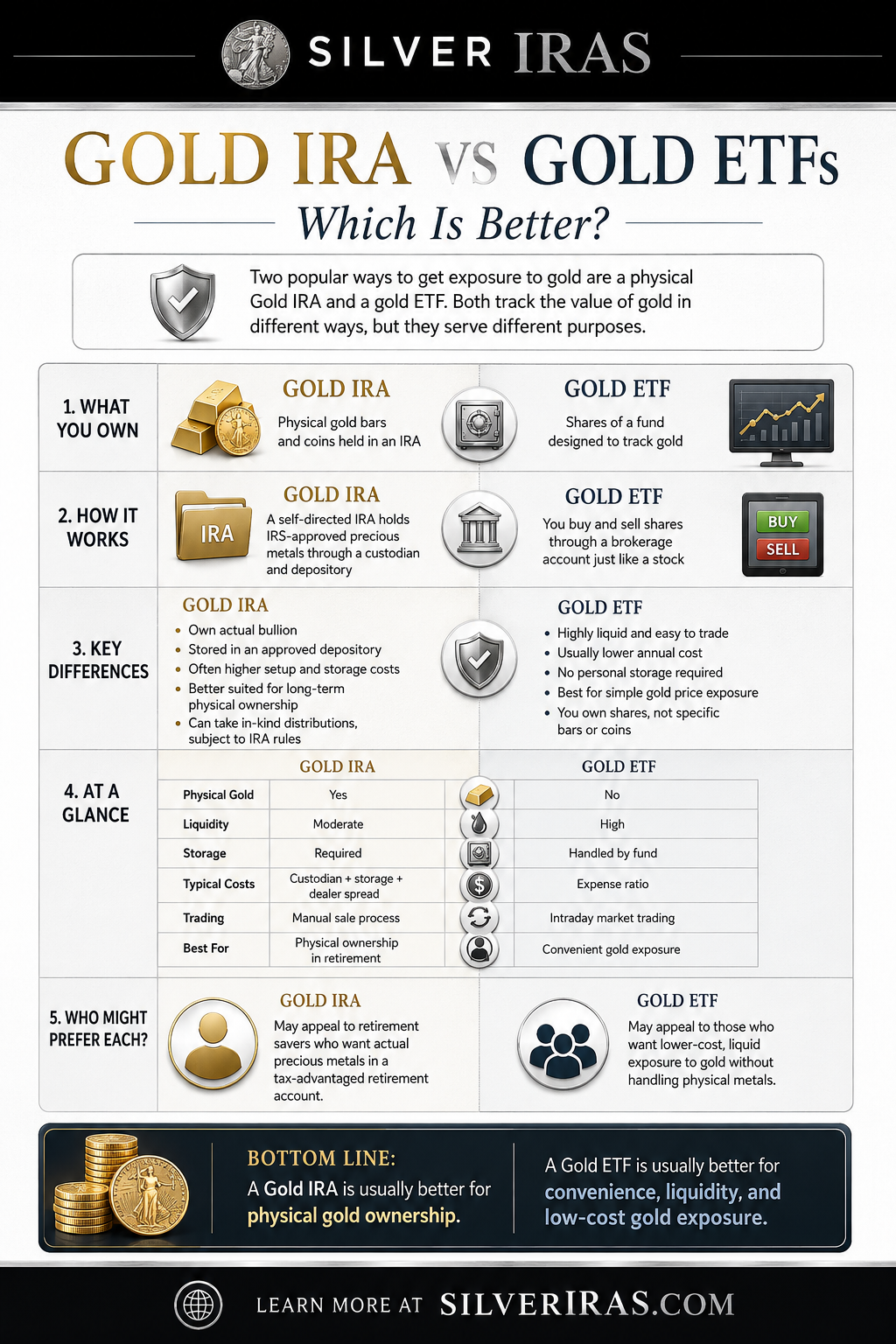
Gold IRA vs Gold ETFs
The Biggest Difference: Physical Gold vs Shares
This is the fundamental difference between the two options.
With a properly structured Gold IRA, your retirement account owns specific physical precious metals stored at an approved depository.
With a gold ETF, you own shares of a financial product.
That distinction may not matter much to someone whose only objective is gaining exposure to changes in the gold price.
But it may matter considerably to someone whose reason for buying gold is to diversify away from financial assets.
Gold ETFs remain securities that are bought, sold, and valued through financial markets. A physical Gold IRA holds tangible bullion outside a conventional stock or bond portfolio.
For many precious metals buyers, that is the primary attraction.
Protect Your Retirement Savings
Free Guide Reveals How to Buy Silver & Gold with Your 401(k) or IRA
Gold ETFs Are Much Easier to Buy and Sell
When it comes to convenience, ETFs have a clear advantage.
Gold ETFs trade on an exchange throughout the trading day. If you decide you want to increase or reduce your gold position, you can generally do so in seconds from a brokerage account.
Selling physical gold from an IRA takes additional steps.
You typically contact the dealer or another precious metals buyer, receive a bid, authorize the transaction through the custodian, and have the metal sold from the account.
It is not necessarily difficult, but it is not instantaneous.
For someone actively trading gold or frequently adjusting portfolio allocations, an ETF is considerably more practical.
Gold IRA buyers tend to be more focused on long-term ownership.
Gold ETFs Usually Cost Less
Gold ETFs generally have another significant advantage: lower ongoing expenses.
For example, IAU currently carries a 0.25% sponsor fee, while GLD carries a 0.40% gross expense ratio.
Physical Gold IRAs usually involve several potential costs instead:
- IRA administration or custodial fees
- Precious metals storage fees
- Dealer premiums or spreads when purchasing gold
- Possible transaction or wire fees
The exact cost varies considerably depending on the custodian, depository, dealer, purchase size, and type of gold selected.
This makes comparison shopping particularly important when opening a Gold IRA.
Buyers should understand both the price of the metal and the fees associated with maintaining the account.
But ETF Fees Never Completely Disappear
One advantage sometimes given to ETFs is that there are no storage fees.
That is technically true from the shareholder's perspective, but the underlying gold still has to be stored, insured, audited, and administered.
Those costs are incorporated into the fund's expenses.
With an ETF, the expense ratio is generally deducted from fund assets over time.
This means your shares represent slightly less gold as expenses are paid.
With physical gold in an IRA, storage and administration costs tend to be more visible because the account holder receives an actual bill or fee schedule.
Neither method of owning gold is completely free.
A Gold IRA Gives You Direct Exposure to Physical Bullion
For some retirement savers, the biggest reason to own gold is precisely because it is not another stock, bond, or paper financial claim.
Physical gold does not depend on corporate earnings. It cannot default like a bond issuer. There are no quarterly earnings reports and no management team running the underlying asset.
A Gold IRA preserves more of that physical ownership characteristic.
The account owns actual bars or coins held in custody.
A gold ETF is different. Even when the trust itself owns physical bullion, shareholders interact with the gold through shares and the financial infrastructure surrounding the fund.
For someone simply seeking price exposure, this distinction may be irrelevant.
For someone specifically seeking physical asset ownership, it can be the deciding factor.
Related: Diversify Your IRA or 401(k) with Physical Gold and Silver (Free Download)
Can You Take the Gold Home From a Gold IRA?
Not while continuing to treat it as an IRA asset.
IRS guidance states that qualifying bullion held by an IRA must generally remain in the physical possession of an eligible trustee or custodian.
However, retirement savers may generally take distributions from an IRA.
Depending on how the custodian handles distributions, it may be possible to take an in-kind distribution of the physical metals rather than selling them for cash.
At that point, however, the distribution becomes subject to the normal tax rules applicable to IRA distributions.
With a traditional IRA, amounts in the account generally remain tax deferred until they are distributed.
This ability to ultimately receive the actual bullion is one characteristic that distinguishes physical precious metals from most gold ETF holdings.
Related: What is a Roth Gold IRA?
Tax Treatment Can Be More Complicated Than It Appears
Taxes are another area where the comparison requires some nuance.
Inside a traditional IRA, both qualifying physical gold and eligible gold ETFs can generally benefit from the IRA's tax-deferred structure. Traditional IRA assets are generally not taxed until money or property is distributed from the account.
Outside an IRA, however, physical gold and physically backed gold trusts can receive tax treatment that surprises some buyers.
The IRS treats long-term gains on collectibles, including gold bullion, differently from ordinary long-term capital gains. The maximum federal rate applicable to collectibles gains is 28%.
Some major physically backed gold products are structured as grantor trusts. GLD's prospectus, for example, states that U.S. shareholders are generally treated for federal income tax purposes as though they directly owned their proportional share of the trust's underlying gold.
Tax rules depend on the exact product, account type, holding period, and individual circumstances, so buyers should consult a qualified tax professional rather than assuming every ETF receives traditional stock-style capital gains treatment.
Protect Your Retirement Savings
Free Guide Reveals How to Buy Silver & Gold with Your 401(k) or IRA
What About Gold Mining ETFs?
Gold mining ETFs should not be confused with physical gold ETFs.
A fund holding shares of Newmont, Barrick Mining, Agnico Eagle, and other mining companies gives you exposure to gold mining businesses, not simply the price of gold.
Mining company shares can be affected by:
- Labor expenses
- Energy costs
- Mine productivity
- Management decisions
- Political risks
- Debt
- Exploration results
- Stock market conditions
Mining stocks can sometimes rise much faster than gold when the metal is performing well.
They can also decline even when gold prices remain strong.
If your objective is to compare a Gold IRA with an ETF that most closely resembles physical gold exposure, physically backed products such as GLD or IAU provide a more appropriate comparison than gold mining funds.
Gold IRA Advantages
A Gold IRA may be particularly attractive to retirement savers who want actual precious metals rather than another security.
Its biggest advantages include physical ownership, diversification away from conventional securities, the ability to hold qualifying bullion within a tax-advantaged retirement structure, and the potential to eventually take physical metals as a distribution.
Gold IRAs can also appeal to people who intend to hold precious metals for many years rather than actively trade them.
The additional friction involved in buying and selling physical metals may even be seen as an advantage by long-term buyers who do not want to constantly trade based on short-term market movements.
Gold IRA Disadvantages
The tradeoff is that physical ownership introduces additional costs and complexity.
Gold IRAs generally require specialized custodial arrangements and approved storage. Physical metals also have dealer spreads between purchase and resale prices.
Selling usually takes longer than clicking a button in a brokerage account.
There are also strict rules regarding which precious metals qualify and how those metals must be held. The IRS confirms that only certain precious metals qualify for IRA treatment and that prohibited collectibles generally cannot be placed inside the account.
Choosing a reputable custodian, dealer, and depository therefore matters.
Related: Home Storage Gold IRA - Allowed By the IRS?
Gold ETF Advantages
Gold ETFs excel in simplicity.
They are easy to purchase, easy to sell, and easy to hold alongside stocks and bonds in an existing brokerage account.
There is no need to locate an approved precious metals depository or coordinate purchases through a self-directed IRA custodian.
Expense ratios can also be relatively low. IAU's current 0.25% sponsor fee means approximately $25 per year for every $10,000 represented by the position, before considering market movements and any applicable brokerage costs.
For retirement savers whose primary objective is simply adding gold price exposure to a portfolio, an ETF can accomplish that efficiently.
Related: Kenny Michaels Makes the Case for Physical Gold and Silver
Gold ETF Disadvantages
The primary disadvantage is that ETF ownership is not the same thing as personally owning bullion.
You own shares.
That means your exposure remains embedded within the financial system through the fund sponsor, trustee, custodian, exchange, brokerage, and other institutions involved in operating and trading the product.
That should not automatically be interpreted as meaning gold ETFs are unsafe. Major gold funds are among the world's largest and most actively traded precious metals products.
It simply means they serve a different purpose.
Someone buying gold primarily because they want an asset outside the conventional securities system may reasonably conclude that an ETF defeats part of the purpose.
Which Performs Better?
If both products provide comparable exposure to gold bullion, their long-term price movements should be broadly similar before accounting for fees, spreads, and other costs.
A Gold IRA does not make gold rise faster.
An ETF does not inherently generate better returns simply because it trades on an exchange.
Both are ultimately influenced primarily by the value of gold.
The difference is how you own it and how much that ownership structure costs.
ETF performance is gradually reduced by fund expenses.
Physical gold purchases may begin with a larger dealer spread between the wholesale value of gold and the customer's purchase price.
That makes holding period especially important.
Someone planning to buy and sell gold repeatedly will generally find an ETF more efficient.
Someone planning to hold gold for 10, 15, or 20 years may place greater importance on owning the underlying physical metal.
Gold IRA vs Gold ETF: Which Is Safer?
"Safer" depends on which risk you are trying to reduce.
If you are concerned about storage, theft, authentication, or ease of liquidation, an established gold ETF offers major advantages.
If you are concerned about concentrating all of your retirement assets within stocks, bonds, funds, and brokerage-held securities, physical gold offers a different type of diversification.
A properly structured Gold IRA still relies on institutions. There is a custodian and a depository involved, so it should not be described as completely outside the financial system.
But the underlying asset is physical bullion rather than a security.
That distinction is important.
Related: Gold vs Cash and Stocks
Can You Own Both?
Absolutely.
This does not have to be an either-or decision.
Someone could use an ETF for liquid gold exposure while also holding physical precious metals for long-term diversification.
For example, a retirement saver might hold a smaller physical gold allocation in a self-directed IRA while using a gold ETF elsewhere in a brokerage or retirement account when greater liquidity is desired.
The two products solve slightly different problems.
Protect Your Retirement Savings
Free Guide Reveals How to Buy Silver & Gold with Your 401(k) or IRA
Who Should Consider a Gold ETF?
A gold ETF may make more sense if your priorities are:
Easy buying and selling.
Low ongoing expenses.
Keeping everything within an existing brokerage account.
Frequently rebalancing your portfolio.
Getting exposure to movements in gold without dealing with physical metals.
For these purposes, ETFs are difficult to beat.
Who Should Consider a Gold IRA?
A Gold IRA may make more sense if your priorities are:
Owning actual physical gold.
Diversifying part of your retirement savings away from conventional securities.
Holding precious metals for the long term.
Using tax-advantaged retirement money to purchase qualifying bullion.
Eventually having the option to receive physical metals through an eligible distribution.
For these buyers, the additional administrative steps and costs of a self-directed IRA may be worth accepting.
Gold IRA vs Gold ETF: Which Is Better?
Neither is universally better.
A gold ETF is generally better as a trading and portfolio-management tool. A Gold IRA is generally better as a physical gold ownership vehicle for retirement savings.
If your goal is simply to participate in movements in the gold price, a low-cost gold ETF offers convenience, liquidity, and inexpensive access.
If your reason for buying gold goes beyond price exposure and you specifically want to own physical bullion as part of your retirement savings, a Gold IRA provides something an ETF cannot fully replicate.
That is ultimately the deciding question:
Do you want exposure to gold, or do you want to own gold?
For buyers who only want the former, an ETF may be sufficient.
For retirement savers who specifically want the latter, a physical Gold IRA deserves consideration.
Related: Download your "Ultimate" Gold and Silver Buyer's Guide
Frequently Asked Questions
Is a Gold IRA better than a gold ETF?
It depends on what you want from gold. Gold ETFs generally offer lower costs, greater liquidity, and easier trading. Gold IRAs provide ownership of physical precious metals within a retirement account. Someone primarily interested in gold price exposure may prefer an ETF, while someone specifically seeking physical bullion may prefer a Gold IRA.
Can I hold a gold ETF in my IRA?
Gold ETFs are available through many retirement brokerage accounts, although available products depend on the financial institution and account. This is why "Gold IRA vs gold ETF" is not technically a comparison between two account types. A Gold IRA usually refers to a self-directed IRA holding physical precious metals, while an ETF is a security that may itself be held within an IRA.
Does a Gold IRA hold real gold?
A properly structured physical precious metals IRA can own actual qualifying gold bars and coins. IRS rules impose restrictions on which precious metals are permitted and require qualifying bullion to be held through an eligible trustee or custodian rather than personally stored by the IRA owner.
Are gold ETFs backed by real gold?
Many major gold products are backed by physical bullion, but structures vary. SPDR Gold Shares and iShares Gold Trust are examples of products designed to provide exposure to physically held gold. Buyers should always read the prospectus for the specific fund or trust they are considering.
Is GLD the same as owning physical gold?
No. GLD owns physical gold, but an ordinary shareholder owns shares of the trust rather than individual gold bars held personally. The trust's prospectus explains that shareholders are treated as proportionate owners of its underlying assets for certain federal tax purposes, but the practical ownership experience is very different from purchasing specific physical bullion through a precious metals IRA.
Are Gold IRAs expensive?
They can cost more than gold ETFs because there may be dealer spreads, custodial fees, and physical storage expenses. Costs vary significantly between providers, so retirement savers should request a complete fee schedule and understand the purchase price of their metals before opening an account.
Can I convert my existing IRA or 401(k) into a Gold IRA?
Eligible retirement assets can often be transferred or rolled over into another qualified retirement account without creating an immediate taxable distribution when the transaction is completed correctly. The IRS notes that eligible rollovers generally are not taxable unless pretax money is being converted to a Roth account. Eligibility and procedures vary by account, so retirement savers should verify the rules applicable to their particular plan before initiating a transfer.
Protect Your Retirement Savings
Free Guide Reveals How to Buy Silver & Gold with Your 401(k) or IRA
Gold ETFs vs Gold IRAs
Gold ETFs and Gold IRAs can both provide exposure to the precious metals market, but they accomplish that goal in fundamentally different ways.
Gold ETFs emphasize efficiency. They are inexpensive, highly liquid, and easy to integrate into an ordinary portfolio.
Gold IRAs emphasize physical ownership. They allow qualifying gold bars and coins to be held within a retirement account, giving retirement savers an alternative to holding all of their assets through conventional stocks, bonds, and funds.
The better choice depends less on where you think gold prices are headed and more on why you want to own gold in the first place.
If convenience and liquidity come first, an ETF is likely the stronger option.
If owning physical precious metals is the objective, a Gold IRA offers the more direct solution.
