Some of the links in this article are affiliate links, which means we may earn a commission if you click and make a purchase or submit your information. This comes at no additional cost to you and helps support our work. Learn more.
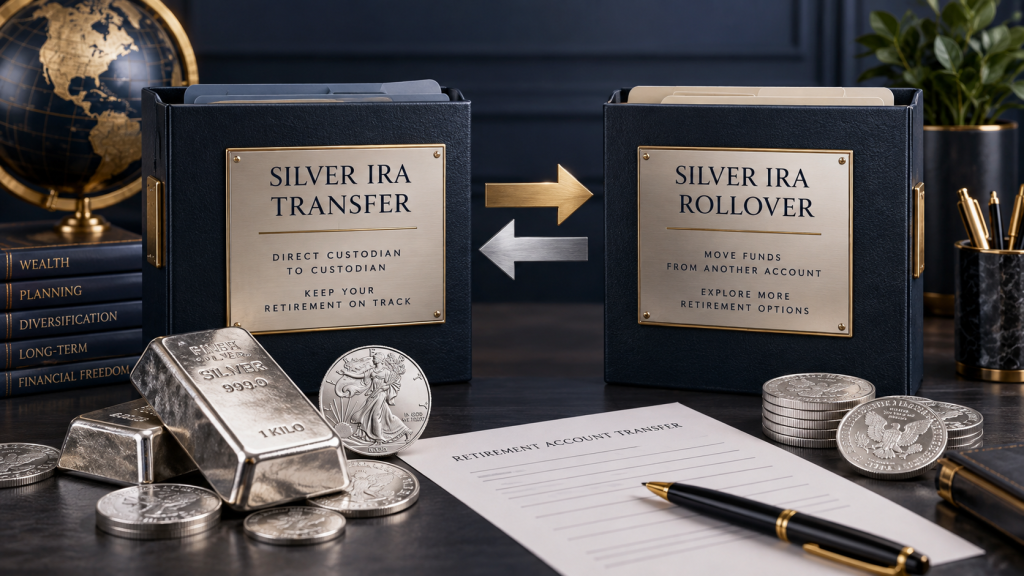
A Silver IRA transfer and a Silver IRA rollover can both move retirement savings into a self-directed IRA that holds eligible precious metals. But they are not the same transaction.
The route you choose affects who handles the money, whether taxes are withheld, which deadlines apply, and how much room there is for an avoidable tax mistake. The differences become especially important when moving money from an old 401(k), TSP, 403(b), traditional IRA, or another retirement account.
This guide explains the three common ways funds move into a Silver IRA: trustee-to-trustee transfers, direct rollovers, and 60-day rollovers. It also covers the IRS one-rollover-per-year rule, mandatory withholding, ineligible distributions, and the steps to take before authorizing a transaction.

Gold IRA Company Checklist 
5 Essential Questions to Ask
Before Choosing a Gold IRA Company.
Use This Free Guide to
Compare Gold Dealers Today.
Silver IRA Transfer vs. Rollover at a Glance
The simplest distinction is the type of account the money is leaving and whether the funds are paid to you.
| Method | Typical starting account | Who receives the money? | Key risk |
|---|---|---|---|
| Trustee-to-trustee transfer | IRA | New IRA custodian | Administrative delays or incorrect paperwork |
| Direct rollover | 401(k), TSP, 403(b), 457(b), or another eligible plan | Receiving IRA or plan | Plan eligibility and account-registration errors |
| 60-day rollover | IRA or eligible employer plan | Account owner first | Deadline, withholding, and one-rollover rule |
A properly completed transfer or rollover generally does not count against the annual IRA contribution limit. It is a movement of existing retirement money, not a new annual contribution.
What Is a Silver IRA Transfer?
A Silver IRA transfer normally means a trustee-to-trustee transfer from an existing IRA to a new self-directed IRA. The current custodian sends the money directly to the receiving custodian. Depending on the institutions, the transfer may be electronic or completed with a check payable to the new custodian for the benefit of the account owner.
The account owner does not receive or control the money. According to the IRS rollover guidance, taxes are not withheld from a trustee-to-trustee transfer. The IRS also states that direct IRA-to-IRA transfers are not subject to the one-rollover-per-year restriction because they are transfers rather than rollovers.
This method can be used to move cash between custodians before purchasing metals. An existing precious-metals IRA may sometimes be moved in kind, but the sending custodian, receiving custodian, dealer, and depository must all be able to support the specific assets and transfer process.
What Is a Silver IRA Rollover?
A rollover moves an eligible distribution from one retirement arrangement into another. For Silver IRAs, this frequently means moving money from a former employer's 401(k), 403(b), governmental 457(b), or TSP into a self-directed IRA.
A rollover can be direct or indirect:
- Direct rollover: The employer plan sends the funds directly to the receiving IRA custodian. A check may be mailed to you, but if it is payable to the receiving custodian for your benefit, it is still generally treated as a direct rollover.
- Indirect or 60-day rollover: The distribution is paid to you. You must redeposit the eligible amount into an eligible retirement account within 60 days.
Plan rules matter. A current employer's plan may restrict distributions while you are still working, while a former employer's plan is often easier to roll over. Before initiating anything, ask the plan administrator whether the requested distribution is eligible for rollover.
For a detailed employer-plan example, see our 401(k) to Silver IRA rollover guide. Federal employees can also review our guide to moving a portion of a TSP to a Gold or Silver IRA.
Direct Transfer, Direct Rollover, and 60-Day Rollover
Trustee-to-trustee transfer
This is generally used between IRAs. The sending IRA custodian delivers the funds directly to the receiving IRA custodian. There is no 60-day deadline for the account owner to meet because the money is not distributed to the owner.
Direct rollover
This is commonly used when money leaves an employer plan. The plan sends the distribution to the receiving IRA or other eligible plan. The IRS says no tax is withheld from a direct rollover.
60-day rollover
This is the higher-risk version because the payment is made to the account owner. The money must generally reach the receiving retirement account within 60 days. If an employer-plan distribution is paid to you, federal income-tax withholding is generally mandatory at 20%.
For example, if a plan distributes $50,000 to you, it may withhold $10,000 and send you $40,000. To roll over the full $50,000, you would generally have to replace the withheld $10,000 from another source within the 60-day period. Otherwise, the amount not rolled over may be taxable and could face an additional tax if no exception applies.
Which Method Is Usually Simpler?
When available, a direct movement between financial institutions is generally the cleaner administrative approach. It reduces the risk of missing a deadline, spending funds that must be redeposited, or failing to replace withholding.
That does not mean every direct transaction is automatic. Retirement savers should still verify:
- The exact legal name and registration of the receiving custodian.
- Whether the sending account permits the requested distribution.
- Whether pretax and Roth money must be separated.
- How after-tax basis will be reported.
- Whether any outstanding plan loan, RMD, hardship payment, or other amount is ineligible.
- How long the funds are expected to remain out of the market.
The precious-metals dealer may help coordinate documents, but the custodian and plan administrator execute the retirement-account transaction. A dealer is not a fiduciary, tax adviser, or plan administrator.
Tax Rules That Can Cause Problems
Missing the 60-day deadline
A distribution paid to you must generally be rolled over within 60 days. The IRS can waive the deadline in certain circumstances, but relief is not automatic. Do not assume a late deposit will qualify.
Failing to replace withholding
Employer-plan distributions paid directly to the account owner are generally subject to 20% mandatory withholding. IRA distributions paid to the owner are generally subject to 10% withholding unless the owner elects otherwise. Direct movements usually avoid these withholding issues.
Attempting to roll over an ineligible distribution
Required minimum distributions cannot be rolled over. Other ineligible amounts can include certain hardship distributions, corrective distributions, deemed loan distributions, and substantially equal periodic payments. The IRS rollover chart shows which account-to-account movements are generally permitted.
Mixing pretax and Roth money
Pretax funds generally move to a traditional IRA if the goal is to avoid a current taxable conversion. Moving pretax money to a Roth IRA generally creates taxable income. Designated Roth plan money must be handled separately from pretax plan money.
Taking possession of IRA-owned silver
Moving retirement cash does not authorize personal possession of IRA metals. After the self-directed IRA buys qualifying silver, the metal must remain under the IRA's approved custodial and storage arrangement. Review our discussion of the home-storage IRA risks.
The One-Rollover-Per-Year Rule
The IRS generally allows only one IRA-to-IRA 60-day rollover during any 12-month period, regardless of how many traditional, Roth, SEP, or SIMPLE IRAs a person owns. The period is measured from the date the distribution is received, not by calendar year.
The restriction generally does not apply to:
- Trustee-to-trustee IRA transfers.
- Rollovers from an employer plan to an IRA.
- Rollovers from an IRA to an employer plan.
- Plan-to-plan rollovers.
- Traditional IRA-to-Roth IRA conversions.
Violating the rule can cause the second attempted rollover to be treated as a taxable distribution. Depositing the money into another IRA may also create an excess contribution subject to a 6% annual excise tax while it remains uncorrected. This is one reason to identify the transaction correctly before moving funds.
IRS Publication 590-A contains the detailed IRA transfer and rollover rules.

Protect Your Retirement Savings
Free Guide Reveals How to Buy Silver & Gold with Your 401(k) or IRA
How to Move Funds Into a Silver IRA
- Open the receiving self-directed IRA. Confirm that the custodian permits physical precious metals and understand its complete fee schedule.
- Identify the source account. Determine whether the funds are in an IRA, 401(k), TSP, 403(b), 457(b), or another plan. This determines whether the movement is normally called a transfer or rollover.
- Confirm eligibility before requesting a distribution. Ask the current custodian or plan administrator which amounts can move and whether the account contains pretax, Roth, or after-tax money.
- Request a direct transaction when appropriate. Obtain the receiving custodian's exact payee language, account number, mailing instructions, and transfer forms.
- Track the funds. Confirm when the sending institution releases them and when the receiving custodian credits the new IRA.
- Review the purchase details. Compare eligible silver products, premiums, spreads, storage costs, and liquidation terms before authorizing a purchase.
- Keep the records. Retain plan statements, checks, transfer forms, confirmations, Forms 1099-R and 5498, invoices, and depository records.
A rollover or transfer is not the silver purchase itself. It funds the IRA. The custodian then uses IRA money to purchase qualifying products at the account owner's direction.
What Happens After the Money Arrives?
Once the receiving custodian credits the self-directed IRA, cash can remain in the account until the owner authorizes a purchase. The dealer provides product and pricing information, while the custodian completes the purchase and directs shipment to the approved depository.
Most silver bullion must meet the federal 99.9% fineness requirement, although specific statutory exceptions exist, including American Silver Eagles. Collectible, rare, and nonqualifying products can create prohibited-transaction or distribution concerns. See our list of IRA-approved silver coins and bars.
Ask for the following in writing before purchasing:
- Total purchase price and total ounces.
- Price per ounce and premium over the prevailing metal price.
- Whether the product is bullion, proof, or another higher-premium item.
- Custodian setup and annual administration fees.
- Depository, insurance, and storage fees.
- The dealer's current buyback process and indicative resale spread.
Our Silver IRA fees guide explains the account costs that can continue after the rollover is finished.
Questions to Ask Before Moving Money
- Is this transaction a trustee-to-trustee transfer, direct rollover, or 60-day rollover?
- Will the check be payable to me or to the receiving custodian for my benefit?
- Will federal or state taxes be withheld?
- Does the source account contain pretax, Roth, or after-tax money?
- Is any portion an RMD or otherwise ineligible for rollover?
- Does the current employer plan allow an in-service distribution?
- What fees will the sending and receiving institutions charge?
- How will the transaction be reported on Form 1099-R and Form 5498?
- Which depository will hold the silver, and is storage segregated or commingled?
- What are the dealer's retail prices, premiums, spreads, and buyback terms?
Consumers comparing providers can begin with our overview of the best Silver IRA companies, but should verify current terms directly before opening an account.
Silver IRA Transfer and Rollover FAQs
Does a transfer count toward the annual IRA contribution limit?
No. A properly completed transfer or rollover generally does not use the annual contribution limit because it moves existing retirement assets rather than adding a new annual contribution.
Can I move an RMD into a Silver IRA?
No. Required minimum distributions are not eligible for rollover. An account owner who must take an RMD should generally satisfy that obligation before moving the remaining eligible balance. See our Silver IRA RMD guide.
Can I transfer an existing precious-metals IRA?
Generally, yes. Cash can usually transfer between custodians. An in-kind transfer of existing coins or bars depends on whether the custodians and depositories support the assets and whether the products remain eligible.
Can I roll over a current employer's 401(k)?
Maybe. The plan may allow an in-service distribution, but many plans restrict withdrawals while the employee is still working. Ask the plan administrator rather than relying on a dealer's general answer.
Will a direct rollover generate tax forms?
It commonly generates Form 1099-R from the distributing plan and Form 5498 from the receiving IRA custodian. A reportable transaction is not necessarily taxable. Keep the forms and have a tax professional confirm the reporting.
Can I move only part of an account?
Often, yes, if the sending plan or custodian permits a partial distribution or transfer. A partial move can leave the remaining assets in the original account, but fees and plan rules should be reviewed.
How long does a Silver IRA transfer take?
Timing varies by institution, paperwork, asset type, and delivery method. Ask both custodians for an estimated timeline and follow up if the funds do not arrive as expected.
Gold IRA Company Checklist
5 Essential Questions to Ask
Before Choosing a Gold IRA Company.
Use This Free Guide to
Compare Gold Dealers Today.
Final Considerations
The phrase “Silver IRA rollover” is often used broadly, but the exact transaction matters. An IRA-to-IRA trustee transfer, employer-plan direct rollover, and 60-day rollover follow different administrative and tax rules.
For many retirement savers, keeping the money moving directly between financial institutions reduces unnecessary risk. Before funds leave an existing account, confirm the transaction type, eligibility, tax treatment, payee instructions, fees, and reporting with the sending plan, receiving custodian, and a qualified tax professional.
Once the IRA is funded, compare qualifying silver products by total cost rather than promotional claims. Review premiums, spreads, custodian charges, depository costs, and liquidation terms before authorizing a purchase.
This article is for informational and educational purposes only and is not financial, tax, or legal advice. Precious-metals dealers do not serve as fiduciaries or tax advisers. Retirement-account rules can change and individual circumstances differ.