

Some of the links in this article are affiliate links, which means we may earn a commission if you click and make a purchase or submit your information. This comes at no additional cost to you and helps support our work. Learn more.
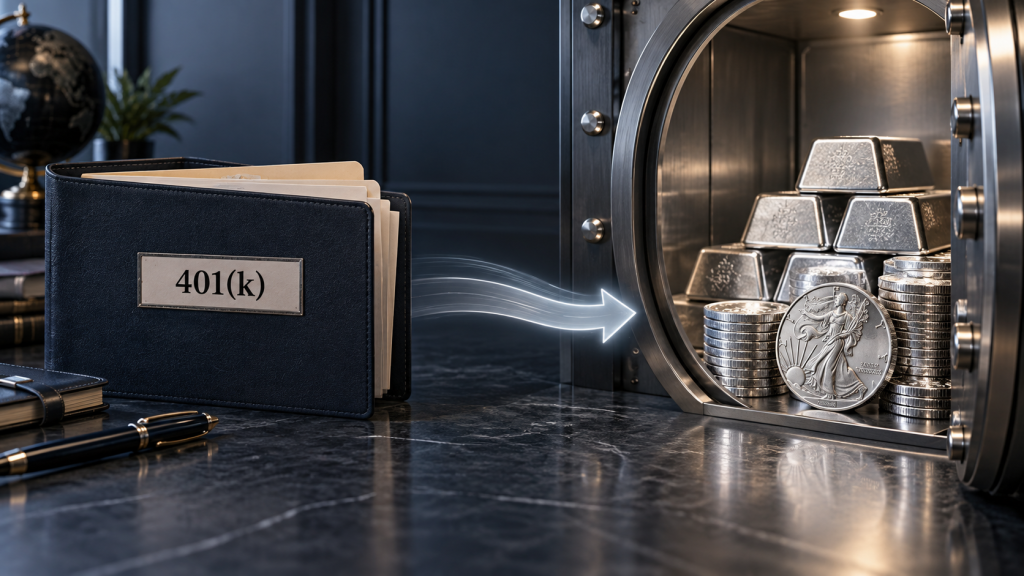
Moving money from an old 401(k) into a Silver IRA can be completed without immediate taxes when the rollover is structured correctly.
The details matter. Eligibility depends on the employer plan, direct and indirect rollovers follow different procedures, and only certain silver products can be purchased inside an IRA. A poorly handled distribution can create withholding, taxable income, or an early-distribution penalty.
This guide explains the rollover process, the parties involved, the IRS rules to watch, and the questions to ask before retirement money leaves a 401(k).

Gold IRA Company Checklist 
5 Essential Questions to Ask
Before Choosing a Gold IRA Company.
Use This Free Guide to
Compare Gold Dealers Today.
Can You Roll a 401(k) Into a Silver IRA?
In many cases, yes. A former employer’s 401(k) can generally be rolled into a traditional self-directed IRA that is able to hold qualifying physical silver. A current employer’s plan may be more restrictive. Some plans allow an in-service distribution after a participant reaches a certain age, while others do not permit money to leave the plan until employment ends.
The first step is therefore not choosing silver. It is asking the 401(k) plan administrator whether the account, or the portion you want to move, is eligible for distribution. The plan’s summary plan description and distribution forms should explain the available options.
A Silver IRA is not a separate tax category. It is a traditional or Roth IRA with a custodian willing to administer alternative assets, including certain bullion. The rollover rules depend on the tax character of the money being moved. Pretax 401(k) money usually moves to a traditional IRA without current income tax. Moving pretax money to a Roth IRA generally creates taxable income.
Direct Rollover vs. Indirect Rollover
A direct rollover is usually the cleaner route. The 401(k) plan sends the money directly to the new IRA custodian, or issues a check payable to the custodian for the benefit of the account owner. The retirement saver does not take possession of the money.
With an indirect rollover, the distribution is paid to the account owner. The IRS generally allows 60 days to deposit an eligible distribution into another retirement account. Employer plans generally withhold 20% of a taxable distribution paid to the participant. To roll over the full balance, the recipient would need to replace that withholding from other funds and later address it on the tax return.
Missing the deadline can turn the unpaid amount into taxable income. An additional 10% tax may also apply when the recipient is younger than 59½ and no exception is available. Because direct rollovers reduce these timing and withholding risks, many consumers prefer them when the plan offers the option.
How a 401(k) to Silver IRA Rollover Works
- Confirm that the 401(k) is eligible. Contact the plan administrator and ask whether a rollover is permitted. Former-employer accounts are commonly eligible; active plans vary.
- Open a self-directed IRA. Choose an IRA custodian that administers physical precious metals and review its fee schedule.
- Request a direct rollover. Follow the old plan’s instructions precisely, including the new custodian’s legal name, mailing address, account number and check-payee language.
- Wait for cleared funds. The new custodian must receive and credit the rollover before purchases can be made.
- Select qualifying silver. Give the custodian a purchase direction for eligible coins or bars from a precious-metals dealer.
- Arrange approved storage. The custodian coordinates shipment to the designated depository. The account owner should not personally receive IRA-owned metal.
- Keep the records. Retain rollover confirmations, invoices, custodian statements and tax forms.
Related: Silver IRA Guide: How to Buy Silver and Gold With Retirement Savings
Which Silver Products Can the IRA Hold?
Not every silver coin or bar belongs in an IRA. Federal law provides limited exceptions to the general restriction on IRA collectibles. Qualifying silver bullion generally must meet a minimum fineness standard, and certain specifically authorized coins can also qualify.
Popular examples may include American Silver Eagles and qualifying .999-fine silver bars and rounds. Collectible value, rarity claims or a high sales price do not make a product IRA eligible. The custodian should confirm eligibility before authorizing a purchase.
Related: IRA-Approved Silver: Coins and Bars That Qualify
The Most Important Tax Rules
The 60-day deadline
If money is paid to you instead of transferred directly, the eligible amount generally must reach the receiving IRA within 60 days. The IRS has limited waiver and self-certification procedures for certain late rollovers, but consumers should not assume relief will be available.
Withholding on a plan distribution
A taxable employer-plan distribution paid to the participant is generally subject to 20% mandatory federal withholding. A direct rollover normally avoids that withholding.
Pretax and Roth money
Pretax assets generally belong in a traditional IRA if the goal is to avoid current taxation. Designated Roth 401(k) assets generally roll to a Roth IRA or another designated Roth account. Accounts containing both types may require separate destinations and careful instructions.
Required minimum distributions
An RMD is not eligible for rollover. Under current federal rules, traditional IRA owners generally begin RMDs at age 73. Employer-plan timing can differ in some circumstances. Consumers subject to an RMD should confirm that the required amount is distributed before attempting a rollover.
Reporting
A tax-free rollover is still reportable. The distributing plan generally issues Form 1099-R, and the receiving IRA custodian reports the contribution. Keep documents showing where and when the money moved.
Related: Gold IRA Tax Rules: Your Precious Metals and the IRS
Fees to Review Before Moving the Money
A 401(k) may have institutional pricing that is less expensive than a self-directed IRA holding physical metal. Before moving money, compare the complete cost of both accounts.
- One-time IRA setup or rollover processing charges
- Annual custodian administration fees
- Depository storage and insurance charges
- Wire, check and transaction fees
- The dealer’s markup above the metal’s wholesale or spot reference price
- The difference between the purchase price and the dealer’s same-day buyback quote
- Future sale, distribution, shipping or account-closing fees
Fee waivers and bonus-silver promotions may reduce a visible charge, but the total purchase price still matters. Ask for the exact products, quantities, metal prices and all fees in writing before approving a trade.
Related: Silver IRA Fees: Setup, Storage, and Custodian Costs

Protect Your Retirement Savings
Free Guide Reveals How to Buy Silver & Gold with Your 401(k) or IRA
Common Rollover Mistakes to Avoid
- Starting before confirming eligibility. An active 401(k) may not allow the requested distribution.
- Having the check made payable incorrectly. Confirm the receiving custodian’s exact instructions before submitting the rollover request.
- Using an indirect rollover unnecessarily. Receiving the money personally adds withholding and deadline risks.
- Buying nonqualifying metal. The custodian should verify IRA eligibility before the transaction.
- Taking personal possession. IRA-owned bullion should move to the account’s approved storage arrangement, not to the retirement saver’s home.
- Ignoring the spread. Administrative fees may be smaller than the difference between a dealer’s selling and repurchase prices.
- Moving the entire 401(k) by default. A partial rollover may be available. Diversification and liquidity needs deserve consideration.
- Treating a salesperson as a fiduciary. Precious-metals dealers sell metal. They are not automatically financial advisers or fiduciaries.
Related: Home Storage Gold IRA: Scam or IRS-Approved?
Questions to Ask the Plan, Custodian, and Dealer
Questions for the 401(k) administrator
- Is my account eligible for a full or partial rollover?
- Does the plan allow an in-service distribution?
- Can you send the money directly to the new IRA custodian?
- How should the rollover check be titled?
- Does the account include pretax, Roth or after-tax money?
- Are there outstanding loans or other restrictions?
Questions for the IRA custodian
- Which depositories and precious-metals dealers can I use?
- What are the setup, annual, storage, transaction and closing fees?
- How much cash must remain in the IRA for expenses?
- How will purchases, sales and in-kind distributions be processed?
Questions for the silver dealer
- What is the total price for each product and quantity?
- What spot-price reference and time are being used?
- What would you pay to repurchase the same items today?
- Is the product confirmed as IRA eligible by the custodian?
- Do promotions affect the price or limit the products offered?
401(k) to Silver IRA Rollover FAQs
Can I move only part of my 401(k) to a Silver IRA?
Possibly. Many former-employer plans allow partial rollovers, but plan rules control availability. Ask the administrator before opening or funding the IRA.
Can I roll over a current employer’s 401(k)?
Sometimes. The plan may permit an in-service distribution based on age or another qualifying event, but many plans require the employee to separate from service first.
Is a direct rollover taxable?
A properly completed direct rollover from a pretax 401(k) to a traditional IRA is generally not currently taxable. A move from pretax funds to a Roth IRA generally is taxable.
Can the silver be stored at home?
IRA-owned bullion is generally required to remain with the IRA’s trustee or custodian under an approved storage arrangement. Taking possession can create serious tax problems.
How long does a rollover take?
Timing varies by the old plan, mailing or wire procedures, the new custodian and whether paperwork is complete. Ask both institutions for realistic processing estimates and track the transfer.
Making the Rollover Decision Carefully
A 401(k) to Silver IRA rollover can provide access to physical silver inside a tax-advantaged retirement account, but it adds specialized custody, storage, pricing and tax considerations. The strongest process begins with eligibility, uses a direct rollover where practical, separates pretax and Roth money correctly, and confirms every product and fee before purchase.
Compare the benefits being given up in the old plan as well. Institutional fees, creditor protections, loan provisions and access to plan-specific funds can matter. A rollover does not have to involve the entire balance.
Consumers who are unsure about the tax consequences should consult a qualified tax professional. A precious-metals dealer can explain its products and prices, but it should not be treated as a substitute for independent retirement, tax or legal guidance.
Related: Best Silver IRA Companies
This article is for educational purposes only and is not financial, tax or legal advice. Precious metals can fluctuate in value, and retirement savers should consult qualified professionals before making decisions involving an IRA.
Gold IRA Company Checklist
5 Essential Questions to Ask
Before Choosing a Gold IRA Company.
Use This Free Guide to
Compare Gold Dealers Today.